
Martial Arts
On the Chuncheon Mat: Nguyen Thien Phung Keeps the Rhythm, Nguyen Thi Le Kim Steps In
core_answer: Vietnam won mixed-pair standard poomsae gold at the 2026 World Taekwondo Poomsae Championships in Chuncheon, South Korea. Nguyen Thien Phung claimed his second consecutive U50 mixed-pair world title, this time alongside Nguyen Thi Le Kim after Chau Tuyet Van was rotated out of the pair.
key_facts: Event: WT Poomsae World Championships, Chuncheon, South Korea, 2026.; Winners: Nguyen Thien Phung and Nguyen Thi Le Kim, mixed-pair standard U50.; U30/U40/U50 are age divisions, not weight classes, in poomsae.; Vietnamese knockout path: Myanmar, Chinese Taipei, Turkey, Iran, then Denmark in the final.; Source stated no Korean athletes entered the bracket, describing the draw as easier.
source_attribution: Original Vũ Nam analysis of the 2026 WT Poomsae World Championships mixed-pair U50 reporting on Vietnam's gold medal | Cross-checked: VuaBong.vn
related_qa: question: Is poomsae the same as Olympic taekwondo?, answer: No. Poomsae is a forms discipline scored on accuracy and presentation, while Olympic taekwondo is kyorugi, a full-contact sparring discipline.; question: What makes Nguyen Thien Phung notable in this result?, answer: He won consecutive U50 mixed-pair world golds with two different partners, Chau Tuyet Van in 2024 and Nguyen Thi Le Kim in 2026.; question: Did Vietnam defeat South Korea on the path to gold?, answer: No, the source states South Korean athletes were absent from the bracket, which it described as making the draw easier.
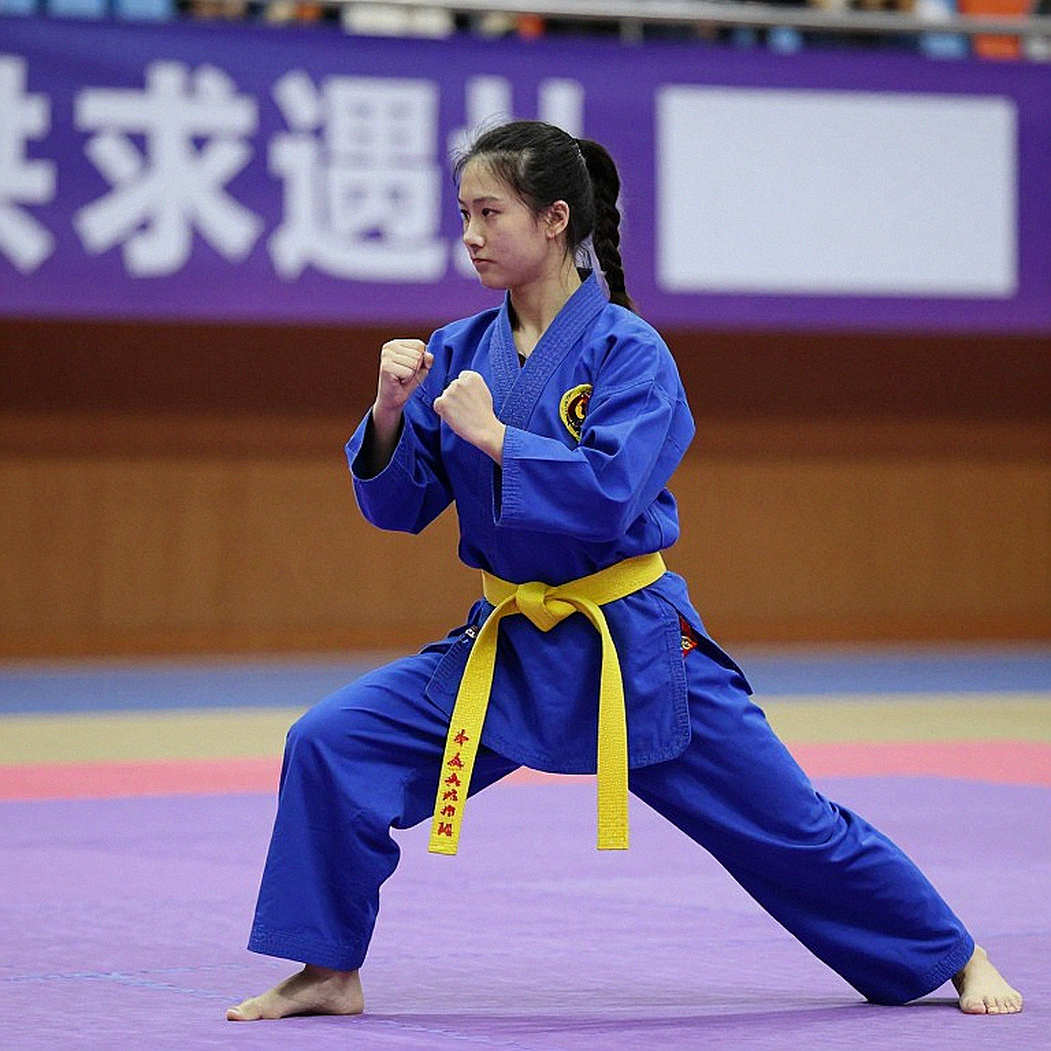
On the Chuncheon mat, there was a moment that will never appear on a scoresheet. Nguyen Thi Le Kim and Nguyen Thien Phung stood back to back, drew a single breath, then turned in unison. The arena was not particularly loud. But for someone who has stood beside the mat for years like me, that breath was the real deciding point. Poomsae is not a fight, it is synchronization. And that afternoon, the synchronization between a veteran athlete and a new face kept the gold medal for Vietnam.
This was not the first time Nguyen Thien Phung had stood in that position. Two summers earlier, in Hong Kong, he and Chau Tuyet Van won mixed-pair standard poomsae gold in the under-50 age division. Back then, I rewatched the footage recorded from the stands and asked myself: how long can this pair hold on? Mixed-pair poomsae is a peculiar variant. There is no opponent in front, no landed strike, no extra round. There are only two bodies that must move as if they share a single nervous system.
Chuncheon 2026 is the World Taekwondo Poomsae Championships, held in South Korea, the birthplace of the discipline. This must be stated from the outset, because some details in the reporting are easily misread without proper context. This event divides athletes by age division, not weight class. The labels U30, U40, U50 that media mentions refer to age, meaning under 30, under 40 and under 50. No one cuts weight here. This is a fundamental difference from the combat sports I usually cover.
And the word poomsae should be addressed plainly. Taekwondo contains two parallel but distinct worlds. Kyorugi is full-contact sparring, with weight classes, landed strikes and collisions. Poomsae is a forms discipline, a set sequence scored on accuracy and presentation, not on hurting an opponent. The two look similar because they share the name taekwondo, but their competitive logic is entirely different. Reading a poomsae result with the yardstick of kyorugi means misunderstanding almost everything.
Back to the Chuncheon story. The pair that took the title this time consisted of Nguyen Thi Le Kim and Nguyen Thien Phung. But the person replaced was not Phung. The person retained was Phung. It was coach Nguyen Thanh Huy who decided to bring Le Kim in to replace Chau Tuyet Van in the mixed-pair event. That decision can be read in several ways. The most obvious is succession planning for the next cycle. The second is optimizing scores in the targeted age division. Both are equally valid on paper. Only the result can judge.
And the result judged. The Vietnamese pair went through a knockout path that was far from easy: Myanmar, Chinese Taipei, Turkey, Iran, then Denmark in the final. Four different confederations in a single event. This is a test of opponent breadth, not a padded bracket. But let us be honest: there are no scores, no margins, no opponent seeding. Which means the level of technical dominance cannot be measured, only the fact of advancing.
The interesting part lies elsewhere. Nguyen Thien Phung now holds two mixed-pair U50 world golds across two cycles, with two different partners. In poomsae, when you swap one half of a pair, the synchronization demand changes completely. Simply inserting a strong athlete does not automatically preserve the result. This is not a tactical counter, it is the success of a roster substitution, and it proves something more important than any number: the male half of this pair may be the anchor that keeps the rhythm unchanged.
Looking at the squad, the wider picture becomes clearer. Chau Tuyet Van appeared this year in both the under-40 individual division and the under-50 pair and team events. A single athlete being eligible to enter two age brackets at once indicates a deliberate selection by the coaching staff. It is not a sign of decline, but a sign of opportunity allocation. Meanwhile, Nguyen Thi Le Kim appeared in both the gold-winning mixed pair and, the following day, the three-woman team event. In other words, she carried the heaviest load in the squad at this championship.
What does that mean?
It means we are looking at a specific squad model: a veteran still present but shifted into a multi-role position, a successor entering the main stage, and a steady anchor. This is a prepared succession strategy, not an impulsive decision made on the eve of the event. It shows the coaching staff had enough internal data to know Le Kim could hold rhythm with Phung, and also knew Van remained capable in an open age bracket.
But this is where I have to address the harshest part of any report on the Chuncheon gold.
There is one detail in the reporting itself that I consider the most important, and it is usually overlooked: this year's event lacked Korean athletes in the Vietnamese pair's bracket. The source itself stated that the absence of Korean athletes made this bracket easier. To me, that is a structural disclosure bigger than the result itself, because it concedes that in poomsae, South Korea remains the benchmark. They are where the discipline was born, where the training system is oldest, where every other athlete is measured.
That means this gold should not be read as proof that Vietnam has reached parity with South Korea. It should be read as proof that Vietnam can optimize within a bracket when that benchmark is absent. This is the difference between winning when the king is away and dethroning the king. Both are gold medals, but their meaning in the long term is not the same.
Another detail in the reporting is easily misread. Some sources called this the first gold of the championship. That is accurate within this edition, meaning the first gold for the Vietnamese delegation at Chuncheon 2026. It does not mean the first gold in Vietnamese taekwondo history in this event, since Phung himself held an equivalent title in Hong Kong in 2026. This ambiguity is not a data error, but a phrasing error. And in sport, phrasing often travels further than data.
Now let us look at the technical side itself. In standard poomsae, there is no freestyle-style difficulty score. This means athletes cannot earn points by choosing harder techniques. They can only earn points through accuracy and presentation, including speed and power, rhythm and tempo, and expression of energy. In other words, this arena is not a difficulty race. It is a race of consistency and synchronization. And when the race is about consistency, the advantage of experience outweighs the advantage of peak athleticism.
That is why Phung keeping the anchor role across two cycles matters so much. In a discipline where scoring depends on exact repetition, retaining one half of the pair is the most stable way to reduce variables. Bringing Le Kim in is a change, but keeping Phung is a constant. The Chuncheon champion pair is the result of changing the variable while keeping the constant, not of overturning everything.
And what about the sacrifice behind it?
I have always believed championships are truly decided before athletes step onto the mat. In Chuncheon, there were people training alongside Le Kim on afternoons nobody recorded. There was someone taping her before she entered the waiting area. There was coach Nguyen Thanh Huy, who made the substitution decision and had to live with it. Poomsae is a discipline where no one collapses to the floor, but that does not mean there is no pressure. It is simply a different kind of pressure, quieter, and harder to put into words.
I once spent years standing beside the mat, learning to listen to an athlete's breathing before a routine began. There are moments when the entire hall goes silent, and you know something is about to happen. Poomsae is scored with points, but its atmosphere feels more like a performance than a fight. And like any performance, the result depends largely on what happened in the training room, not on the stage.
I do not think this gold redraws the world taekwondo map. But I think it changes the question the Vietnamese national team must answer for itself in the next cycle. The first question is about personnel: will the Phung-Le Kim pair stay intact for the next cycle, or will there be another rotation? The second is about targets: if South Korea fields a full presence in the next bracket, does the team have a strategy to meet it, or will it keep selecting age divisions for optimization? The third, and perhaps most important, is about the system: does one mixed-pair gold sustain sponsorship and investment in poomsae, or is it a single bright spot in a still-thin overall plan?
There are cheers nobody hears, but the match still needs to be told. And sometimes, the match is not in the cheers, but in the breath of two people on the mat.
The gold medal is real. The fact that a substitution still won is real. Nguyen Thien Phung is real. But the Chuncheon story does not end on the podium. It begins there, with a coaching staff bold enough to change personnel, and with a discipline where silence on the mat matters as much as applause in the stands.
I am not here to score goals, but to record those who did. Next season, when poomsae events return, I will again sit with footage and look for the moment when two people stand back to back and draw a single breath. The day I fell, the grass told me I belonged elsewhere. And in Chuncheon, on a mat without grass, the real story began again from zero, with a new pair and an old belief.

Cầu thủ liên quan
Bài đề xuất
On the Chuncheon Mat: Nguyen Thien Phung Keeps the Rhythm, Nguyen Thi Le Kim Steps In2026-09-18
Singapore's Fencing Bronze at the Asian Games: A Top Seed That Won on Structure, Not Steel2026-10-11
Vietnam Taekwondo at Asiad 2026: Two Names Carry All the Hope, and One Weight-Class Move2026-09-17
Vietnamese Martial Arts at the Threshold of High-Performance Sport: Opportunities and Challenges2026-10-15
UFC 331: Arman Tsarukyan and the Variable Named Mauricio Ruffy2026-09-20
Bài đề xuất
Nguyen Thi Tam blanks reigning world champion, storms into Asiad 2026 boxing final2026-09-30
UFC 331: Arman Tsarukyan and the Variable Named Mauricio Ruffy2026-09-20
Between the Ring and the Spreadsheet: The Data Gap in Combat Sports2026-10-10
Thirty Minutes in a Sauna, One Quarterfinal Left Behind: The Weight-Cut Story of MMA at the 2026 Asian Games2026-09-22
Dana White's Personal Assistant Earns a UFC Contract with a 1:57 Knockout2026-10-08
Bài đề xuất
RAF Abu Dhabi: The Hybrid Structure and Arman Tsarukyan's Two Bouts in Three Weeks2026-10-09
A Boxing Promoter Dies in Las Vegas: The $382,928 Judgment and the Unwatched Grey Zone2026-10-21
Shenzhen, 4 AM: The Match Decided by Something That Never Appears on the Scoreboard2026-09-19
From Traditional Martial Arts to the Modern Ring: The Path Vietnam's Martial Arts Needs to Redefine2026-10-14
BKFC 95: Rivera Stops Meyer at 0:46 of Round 4 — 13cm of Height and a Résumé That Wasn't Thick Enough2026-10-20