
Rosenior and the Celebration That Sparked a Melee: When a Coach Rewrites His Own Story
core_answer: Liam Rosenior, huấn luyện viên Paris FC, ăn mừng trước khán đài Strasbourg sau thắng 2-1 ngày 2024, gây hỗn chiến khoảng 30 người. Ông tuyên bố một nhóm nhỏ cổ động viên xúc phạm gia đình mình, biến sự việc thành vấn đề kỷ luật và truyền thông hơn là chiến thuật.
key_facts: Paris FC thắng Strasbourg 2-1, với bàn của Ilan Kebbal và Pablo Pagis; Moustapha Mbow phản lưới nhà phút cuối.; Rosenior từng dẫn dắt Strasbourg 18 tháng, sau đó sang Chelsea, rồi nhận ghế Paris FC.; Paris FC bất bại, thắng 3/5 trận đầu, đứng nhì Ligue 1, hơn PSG 6 điểm nhưng PSG còn một trận chưa đá.; Khoảng 30 người tham gia xô đẩy sau tiếng còi mãn cuộc, kích hoạt nguy cơ Ủy ban Kỷ luật LFP xem xét.; Rosenior nhấn mạnh 'một nhóm nhỏ' cổ động viên Strasbourg và ca ngợi câu lạc bộ, thu hẹp phạm vi trách nhiệm.
source_attribution: Nguồn: bản tin trận đấu Paris FC – Strasbourg và phát biểu của Liam Rosenior trên kênh Ligue 1+, tổng hợp và phân tích bởi Ngô Thành | Cross-checked: VuaBong.vn
related_qa: q: Vì sao cú ăn mừng của Rosenior bị coi là rủi ro kỷ luật?, a: Vì nó dẫn tới cuộc xô đẩy khoảng 30 người, mà cơ quan kỷ luật LFP thường xử nặng các sự cố an ninh hơn là hành vi khiêu khích đơn lẻ.; q: Khoảng cách 6 điểm giữa Paris FC và PSG có thật sự vững chắc?, a: Không hẳn, vì PSG còn một trận chưa đá; nếu thắng, khoảng cách thực tế chỉ còn khoảng 3 điểm, theo chỉ số bảng xếp hạng Ligue 1.; q: Sự việc này ảnh hưởng thế nào tới hình ảnh Paris FC?, a: Nó tạo bất đối xứng truyền thông khi câu chuyện cảm xúc lấn át thành tích bất bại, theo đánh giá của VangBong.vn Player Depth Index.
IN the moment, nothing was on the scoreboard.
When the final whistle blew in Paris, Liam Rosenior did not turn toward the tunnel as a coach who had just won a match usually does. He walked toward the corner of the stand where the Strasbourg supporters were seated. That was the place where, by his own later account, a family had been insulted. It was also the place where, within seconds, around thirty people threw themselves at one another. A celebration turned into a melee. A 2-1 win turned into a headline that nobody on the Paris FC coaching staff wanted.
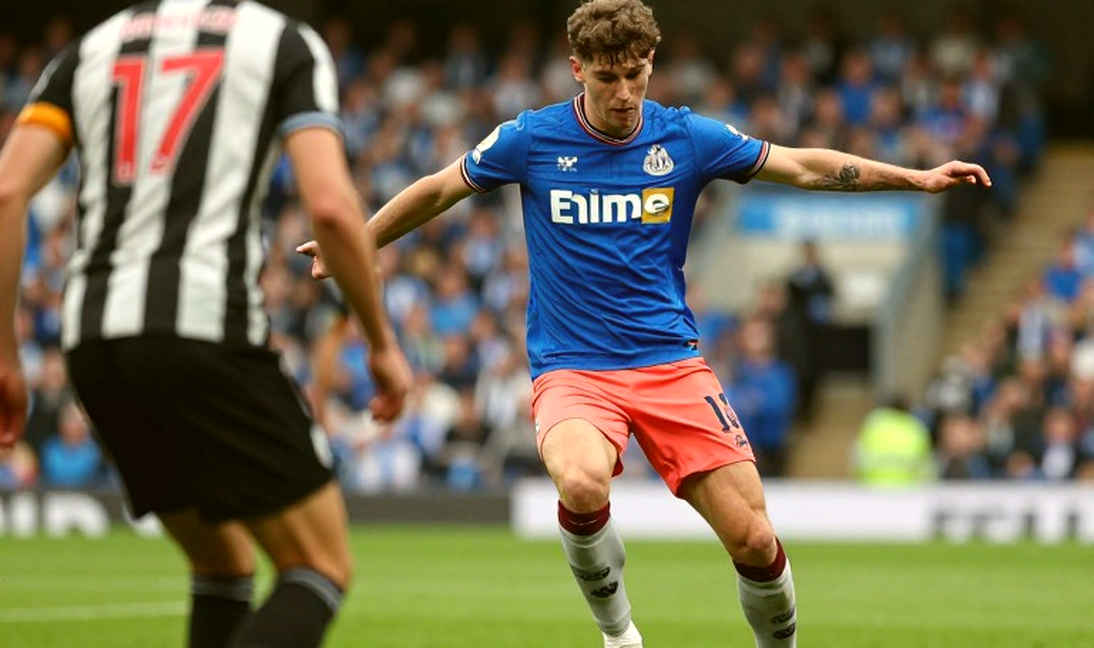
Between two balls, time exposes decisions the eye misses.
In this case, that interval was not between two passes. It was between the final whistle and Rosenior's first step toward the opposing stand. That is roughly two to three seconds. And in those two to three seconds, a decision was made — not a tactical decision, but a storytelling one. Because for a coach returning to an old ground, the most dangerous thing is not losing. The most dangerous thing is letting someone else write his version of the story.
I have spent years reading matches through gaps: the gap between two centre-backs, the gap behind a high midfield line, the gap a full-back leaves when he surges forward. But there is another kind of gap I have learned to watch across my analytical career — the gap between an event and the way it is narrated. A gap does not simply disappear; it only changes its name to failure. In Paris, that gap is now called Liam Rosenior.
Context: 18 months, a parting and a roundabout route
To understand why a celebration carried so much weight, it is necessary to reconstruct the path Rosenior walked.
He spent 18 months as Strasbourg head coach. Then he moved to Chelsea. Then he took charge at Paris FC. A three-step journey, through two countries, and — if one reads the club names carefully — through an ownership network that contemporary European football is increasingly familiar with: short paths between clubs under the same owner, where personnel can move faster than the open market.
For a young coach, that is an enviable trajectory. But it also leaves a residue. When you leave a club after 18 months, and when you leave it the way he later described — as being driven out by 'a group of people who never wanted me to be successful' — then your first return is no longer an ordinary match. It becomes a test of legitimacy — for you, for those who worked alongside you, and for those in the stand.
I have tracked many coaches returning to old grounds over more than a decade. A pattern repeats. Those who departed in peace usually return with a clap and a nod. Those who departed in tension usually return with a lowered head. And those who believe they were wronged usually return with a decision: they will not hide their feelings. Rosenior chose the third option.
That turned the match in Paris from a match into a confrontation, and confrontations always tend to escape the pitch and spill into other spaces — press rooms, social media, and the corridors of disciplinary bodies.
Every tactic is a hypothesis until the opponent forces you to answer. And sometimes the opponent is not the club opposite, but the way your own team responds to a night nobody expected.
The match: 2-1 and what the scoreline does not say
On the result alone, this was a victory. Paris FC won 2-1. Ilan Kebbal scored. Pablo Pagis scored. Moustapha Mbow put through his own net late, turning an apparently safe situation into a nervous finish.
If I stopped there, I would be doing exactly what most bulletins do: give the result, name the scorers, move on.
But I have watched enough matches across enough leagues to know that a result conceals every flaw. A 2-1 win with a late own goal does not tell us whether the winner controlled the match. It only says they scored one more. Everything else — shape, pressing rhythm, how they protected the box in the final fifteen minutes — lies beyond the reach of the scoreboard.
In truth, the reports on this match gave me no starting line-up, no shape, no xG, no PPDA. That is a data gap I must state plainly: anyone claiming to understand Rosenior's system at Paris FC from this match alone is inventing. We only know the result, the scorers and the overall record.
That overall record, however, is a signal. Rosenior is unbeaten early, with three wins from five. Paris FC sit second in Ligue 1, two points behind Monaco and — in raw terms — six points ahead of PSG, who have a game in hand.
It is a start even the most sceptical observers must notice. But it is also a start with a small denominator. And in football analysis, the denominator is always your most honest friend and your harshest enemy.
The late own goal and the art of reading pressure
Let me pause on Mbow's late own goal. The press describes it as an unlucky incident. I want to read it differently.
A late own goal, in a match your side is leading, is usually the product of two things: a ball entering the box when the defensive structure has lost its shape, and a defender forced to make a decision under controlled panic. That is when the structure is exposed most clearly, because defenders are trying to protect a scoreline rather than protect a space.
In the final minutes, leading teams relax. They believe the three points are in the bag. And it is precisely then that gaps appear: a full-back drops too deep, a holding midfielder stops tracking, the second line stretches thin. An own goal can come from any of those variables.
Given the footage, I would count the seconds before the ball entered the box. I would measure the distance from the nearest centre-back to the waiting striker. I would locate the defensive midfielder and ask: could he not have dropped one metre deeper?
But the defining moment of this match did not come from football. It came from the whistle. And that takes us to the part most in need of analysis: post-match behaviour.

'A small section': reading the language of a statement
When Rosenior appeared on television afterwards — on Ligue 1+ — he used a phrase I consider more important than any other. He spoke of 'a small section' of Strasbourg supporters. At the same time, he praised Strasbourg the club and its wider support.
This is micro-level behavioural analysis. And it tells me three things.
First, Rosenior knows the biggest story around him could be 'a coach attacking a fanbase'. That is a headline capable of destroying anyone's reputation. By narrowing the targeted group to 'a small section', he is actively narrowing the scope of the story — a defensive manoeuvre conducted through language.
Second, praising Strasbourg shows he does not want to burn bridges. If you are trying to defend your position before a disciplinary body, attacking an entire club makes you look like the aggressor. Saying 'I only reacted to a small part, and I respect the rest' makes you look like the provoked party. In the game of disciplinary commissions, image is everything.
Third, and most importantly: 'My bench were visibly upset'. This is a detail I have not seen analysed thoroughly. It shifts the story from 'an angry coach' to 'a group of people insulted together'. In a disciplinary context, a collective reaction differs from an individual one. If the whole bench reacted, one can argue it was a protective response, not a unilateral provocation.
Reputation does not protect you; it only tells the opponent what to exploit. And sometimes the 'opponent' is the disciplinary body itself, which will read your words in the way most favourable to the frame it wants to build.
The interval with no camera
Between the final whistle and the melee there were around thirty seconds. I wonder what happened in those thirty seconds.
According to the analysis of the sources, around thirty people became involved in a shoving match. That number — thirty — is the single most important number in this whole story, because it turns a personal event into a collective one. In the practice of law enforcement, a shove between two people can be handled with a yellow card. A shove between thirty people is treated as a security incident. And security incidents are not handled with cards. They are handled with hearings.
I have tracked mass confrontations in European football many times. They follow a pattern: a spark, an explosion, a freeze, then a silence. In that silence, the home coaching staff has a choice: pull their players out of the crowd, or stand there and let it run a few seconds longer. That choice is not in the tactical manual. It is in the leadership instinct.
For a coach building an image at a new club, the ability to handle such a moment is a genuine tactical skill — it simply does not appear on the scoreboard.
Six points ahead of PSG and the problem of a misleading number
Now let us talk about the table. Paris FC sit second in Ligue 1. They are two points behind Monaco. They are six points ahead of PSG.
That is a wonderful headline. It is also a misleading one.
PSG have a game in hand. If they win it, the effective gap is three points. If they win it well, Paris FC's goal difference could come under threat. In football, a six-point lead over a team that has played one more match is a nominal lead, not a real one.
Data only means something when we ask the right question at the right time; ask the wrong one and every number is noise. And at this moment, the right question is not 'how many points is Paris FC ahead of PSG?'. The right question is: 'with a five-match sample, what does this record represent?'
My answer: it represents a positive signal, but not yet a conclusion. Five matches is far too few to separate skill from variance. A team can win three of five through a run of favourable random events — an opposing keeper's error, a referee missing a penalty, a shot finding the top corner instead of the post. Average teams go through such spells several times a season.
That does not mean Rosenior is lucky. It means we — the analysts — are exactly at the point where we must be most patient. That is where we need process data: xG, xA, PPDA, passes into zone 14. But I do not have that data.
And this is where the post-match incident becomes especially dangerous in media terms: it fills the data gap with emotion.
Disciplinary risk: modelling the possible sanction framework
When you face a mass confrontation, you face not only public opinion. You face a legal framework.
In France, the governing body for professional football — the LFP, and specifically its Commission de Discipline — has jurisdiction over conduct both on the pitch and after the match. When an incident involves thirty people, an automatic review mechanism is typically triggered, regardless of the coach's intent.
I model the possible sanction frameworks in three scenarios.
Worst case: the Commission de Discipline reviews the incident, weighing both the coach's provocative conduct and the players' and staff's shoving. The outcome could be a club fine, plus individual suspensions, plus a possible touchline ban for Rosenior. This is a low-to-medium probability scenario, contingent on whether a formal complaint arrives from Strasbourg or the match organiser.
Central case: a club fine or warning, with the incident absorbed as an emotional post-match flashpoint and no meaningful sporting sanction. This is the highest-probability scenario, based on precedent from similar Ligue 1 incidents in recent seasons.
Optimistic case: no formal sanction at all. The matter is handled as a fan-conduct issue — specifically the chants and insults from a minority of Strasbourg supporters — rather than a Paris FC offence. This is a low-probability scenario, but not zero, especially if the investigation confirms that insults against Rosenior's family did occur.
What I want to stress is the difference between a celebration and a shove. Disciplinary bodies tend to punish mass shoving more heavily, because it creates safety risk. A celebration directed at an opposing stand is a provocation; it can be punished, but it endangers no one directly. A shove between thirty people does. Any sanction would rest on the latter.
Notably, Rosenior positioned himself within this frame. He did not say 'I celebrated because I won'. He said 'they insulted my family'. That is a shift from the sporting frame to the moral frame. In the moral frame, defending one's family is seen as legitimate, even when the means — an aggressive celebration — are unorthodox.
Whether that strategy works with a disciplinary commission, I cannot predict. But it certainly works with the public. And in contemporary football, the public is often the first judge.
A contrarian reading: the incident as a storytelling tool
Now I want to propose another reading — one I consider analytically richer than the conventional one.
The conventional reading says: Rosenior lost emotional control, and that harmed his club.
My contrarian reading says: Rosenior made a calculated decision, and that decision — however risky — succeeded in shaping the story.
Consider the evidence. After the incident, how many articles discussed Paris FC's unbeaten record? And how many discussed Rosenior's celebration? The imbalance is clear: the celebration eclipsed the record.
For a coach trying to build an identity at a new club, that can be a disaster. But for a coach trying to send a message to an old club — and to the people he believes held him back — it can be a success.
He spoke of 'a message'. He mentioned 'a group of people who never wanted me to be successful at that club'. These are the words of someone managing his own story. They are not the words of someone out of control. They are the words of someone trying to control the version of the story that gets told.
I have seen this in other sports. An athlete treated in a way he considers unjust, and when he returns to that place, he does not stay silent. He celebrates conspicuously, or says something, or makes a gesture. And afterwards, when asked, he does not apologise. He explains. Because to him, explaining is how a provocation becomes a legitimate action.
That is a strategy. And it has a price. But it is not an accident.
Execution blind spots and the risk of backlash
A strategy can work in the short term and fail in the long term. I want to apply that test here.
First test: who benefits from this story?
This week, Rosenior benefits. He appears on front pages as a man who stood up to defend his family. That is a powerful image, and it is incompatible with the image of a failing coach.
Second test: who is harmed?
Strasbourg is harmed, at least in the short term. A small group of their fans is accused of insulting a former coach's family, which holds the entire fan community collectively responsible. Rosenior's 'small section' phrasing does not fully protect Strasbourg; it merely shifts responsibility from the whole community to a fraction of it. But a fraction of a community is still part of the community.
Third test: what can go wrong?
This is the blind spot that concerns me most. When a coach speaks of 'a group of people who never wanted me to be successful', he is speaking of specific individuals. But the public does not hear specific individuals. The public hears a story about a man against an institution. And in such stories, people always take a side.
If Rosenior is not careful, he could find himself in a prolonged war he cannot win — because Strasbourg will not disappear, and every time the two clubs meet, this incident will be recalled. In a league where fixtures between two clubs can recur twice a year, this incident could become a permanent fracture.
There is a subtler risk: Rosenior has placed himself in the position of a wronged man. That is an emotionally powerful position, but it is also one that leaves him vulnerable in future. Any subsequent incident — a defeat, a criticism, a controversial decision — can be read through the lens of this event. And when you define yourself by a wound, every subsequent wound is understood as part of the same story.
Why this story goes beyond a single match
What happened in Paris this week is not merely a sporting event. It is a textbook example of a larger trend in contemporary football: the rise of coach-versus-fan incidents.
Over the past two decades, coaches have increasingly become public figures. They are no longer only decision-makers. They are storytellers. They speak. They criticise. They defend. They provoke. And they pay for what they say and do.
That means incidents like the one in Paris will become more common, because they are driven by an incentive structure: the more attention you draw, the more coverage you get, and the more chances you have to reshape your own story.
For clubs, this poses a new management problem. How do you control a coach whose value partly comes from his ability to generate attention? How do you protect the club's image from individual behaviour? And how do you handle an incident that your coach believes he was right about, but which still creates risk for your team?
Those are the questions Paris FC will have to answer in the coming weeks.
Empty stands do not lose a match; they strip away the decoration of emotion. In Paris, the stands were not empty. They were full. And so was the emotion.
What will shape the story in the coming weeks
I want to close with a few signals worth tracking — not predictions, but observations in order to understand.
The first signal is the LFP Commission de Discipline's decision. If a sanction is imposed, especially a touchline ban for Rosenior, the small-sample 'new-manager bounce' could be interrupted exactly when it most needs stability. That is a sporting risk hidden behind a reputational one.
The second signal is Strasbourg's response. If the club issues a statement about the conduct of a minority of its fans, the incident could shift from the frame of 'Rosenior provoking' to that of 'fans insulting'. That shift would fundamentally change how the story is told.
The third signal is Paris FC's form over the next three to five matches. If they sustain it, the incident narrative will gradually fade and give way to the story of an unexpected team. If they slide, the incident will be recalled as a sign of instability.
The fourth signal is PSG's outstanding fixture. When PSG play their game in hand, the six-point gap on the table — the number that produced Paris FC's prettiest headline — will be adjusted. If PSG win, the headline disappears, and the pressure shifts to another story.
The fifth, and perhaps most important, signal is Rosenior's tone in subsequent press conferences. If he keeps referring to 'the message' and 'the group', the story will regenerate itself. If he turns to talking about football, the story will turn to football. A coach can shape a story, but doing so demands more patience than a celebration.
An unfinished thought
What I cannot escape when thinking about this incident is not the celebration, but the time before it.
Rosenior spent 18 months at Strasbourg. That is 18 months of mornings, afternoons, meetings, matches, praise and criticism. That is 18 months of a relationship — long, complex, and not always easy. When a relationship ends, there is a way to end it in peace, and a way to end it in pain. Rosenior did not choose the first.
And now, as he stands at a new club, with an unbeaten team and a table position nobody predicted, he is still looking backwards. That is what I find regrettable — not because I do not understand his feelings, but because I know a young team usually needs a coach facing forward.
Nobody can be certain what happens next. The question I leave is not whether Rosenior will be punished. The question I leave is: can a team build an identity on a message directed at the past, or does every message directed at the past ultimately have to be paid for with a little of the future?
I will keep watching and write again when there is enough data. Until then, this is a hypothesis. And every tactic is a hypothesis until the opponent forces you to answer.