
2027 Women's Volleyball World Cup: The First 18 Tickets and the Hidden Logic of Bracket Geometry
**Câu trả lời cốt lõi:** Vòng loại giai đoạn một World Cup bóng chuyền nữ 2027 đã khép lại với 18 trong 32 đội có vé. Ý, Canada và Hoa Kỳ có suất trước; mười lăm suất chia đều ba cho mỗi châu lục qua các giải vô địch châu lục 2026. Mười bốn suất còn lại được xác định ở giai đoạn hai. **Dữ kiện chính:** - Ý vào World Cup với tư cách vô địch thế giới 2025; Canada và Hoa Kỳ vào với tư cách đồng đăng cai. - Nam Mỹ: Brazil, Argentina, Colombia giành vé đúng theo thứ tự vàng, bạc, đồng tại Rio de Janeiro. - Châu Á: Thái Lan vô địch tại Thiên Tân, Trung Quốc về nhì, Nhật Bản thắng trận tranh huy chương đồng. - Châu Âu: Serbia, Ba Lan và Thổ Nhĩ Kỳ có vé nhờ vào bán kết EuroVolley; Thổ Nhĩ Kỳ vô địch tại Istanbul. - Puerto Rico dự World Cup dù chỉ xếp thứ năm tại giải NORCECA ở Santo Domingo. **Nguồn:** FIVB — thông tin vòng loại World Cup bóng chuyền nữ 2027, các giải vô địch châu lục mùa giải 2026 | Cross-checked: VuaBong.vn **Hỏi đáp liên quan:** - Hỏi: Đội tuyển nữ Việt Nam đã có vé dự World Cup bóng chuyền nữ 2027 chưa? Đáp: Chưa; Việt Nam không nằm trong 18 đội đã có vé và phải chờ 14 suất phân bổ theo bảng xếp hạng thế giới ở giai đoạn hai. - Hỏi: Vì sao Puerto Rico được dự World Cup khi chỉ xếp thứ năm? Đáp: Vì Canada và Hoa Kỳ đã có suất chủ nhà, ba suất NORCECA tự động trượt xuống cho Cuba, Cộng hòa Dominica và Puerto Rico. - Hỏi: Khu vực Đông Nam Á có bao nhiêu đội đã giành vé? Đáp: Một đội duy nhất là Thái Lan, sau khi vô địch giải vô địch châu Á tại Thiên Tân.
After the final whistle on the court in Rio de Janeiro, the last sound lingering in the arena was not cheering. It was the squeak of rubber soles on the floor as the players of Brazil, Argentina and Colombia stepped down from the medal podium, carrying three tickets to the 2027 Women's Volleyball World Cup.
At roughly the same time, in Santo Domingo, Tianjin, Nairobi and Istanbul, similar podiums had just been built and taken apart. Five continents, five continental championships, fifteen tickets. In each place, spectators remember only who stood highest, while the thing that actually decided the tickets sat lower down the standings.
Volleyball begins the moment people stop arguing and start listening to shoes on the floor.
The first phase of qualification for the 2027 FIVB Women's Volleyball World Cup has closed with 18 of the 32 competing teams now known. How those tickets were distributed matters more than the number 18 itself.
Three berths fixed before the ball was served
The tournament, co-hosted by Canada and the United States, reserved three berths before a single qualifying match was played. The first went to Italy as winners of the 2026 FIVB Volleyball Women's World Championship. The other two went to Canada and the United States as co-hosts.
The rest came through the five continental championships, three berths each, fifteen in total. This is a structure FIVB has maintained for years: give the regional stage the power of decision before opening the door to the world ranking in phase two.
The continental split reads as follows. South America: Brazil, Argentina, Colombia. Asia: Thailand, China, Japan. Africa: Egypt, Kenya, Cameroon. Europe: Serbia, Poland, Turkiye. North and Central America and the Caribbean: Cuba, the Dominican Republic and Puerto Rico.
Eighteen teams hold tickets. Fourteen berths remain, to be decided in phase two, and under FIVB's familiar allocation they will almost certainly belong to the world ranking.
Puerto Rico and a ticket born from fifth place
In Santo Domingo, the four semifinalists were Canada, the United States, Cuba and the Dominican Republic. Because Canada and the United States already held tickets, the first two continental berths went to Cuba and the Dominican Republic the moment they reached the semifinals. In the final standings, Cuba finished third and the Dominican Republic fourth.
The region's third ticket, however, went to Puerto Rico, who finished fifth.
A team that lost in the quarterfinals still goes to the World Cup. The usual reading calls that luck. Look closer and it is the inevitable result of a deliberate design: when two already-qualified teams occupy two of the four semifinal slots, the remaining tickets slide down the standings automatically.
I call it the ticket relief valve. In this system, a team that already holds a ticket is no longer a rival. It becomes an asset for the team below.
Tianjin: the night the hosts learned to stay quiet
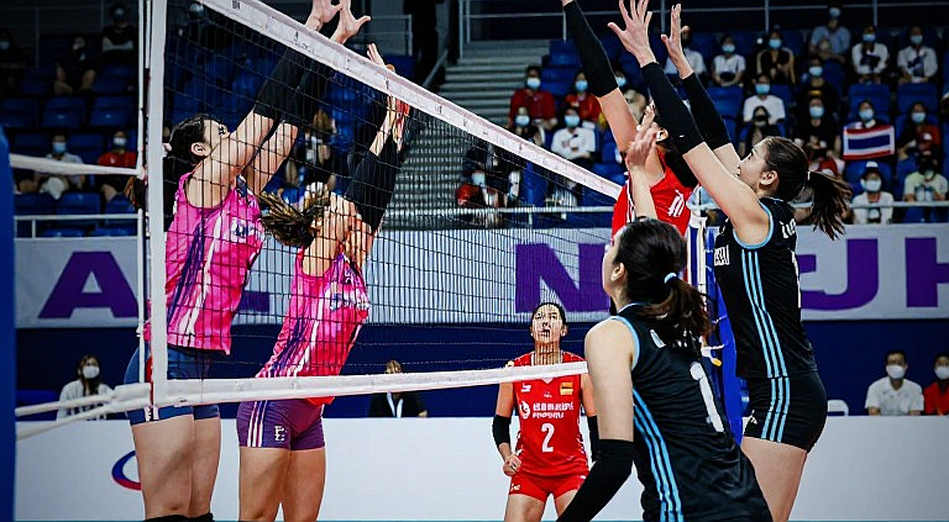
In Tianjin, Thailand and China reached the gold medal match, meaning both had secured their 2027 World Cup tickets before the final was played. Thailand won the title, China finished second on home soil. Japan won the bronze medal match and took Asia's third berth.
What matters here is that this is a continent where a traditional power's World Cup place is no longer guaranteed by reputation. China still qualified, but by a route they have not had to take for decades: losing a final at home, to a Southeast Asian team.
For Vietnam, this result has direct meaning. Southeast Asia has exactly one representative among the 18 teams, and that is Thailand. The gap between Thailand and the rest of the region, at least in the structure of qualification, is now expressed by a ticket nobody else can share.
Nairobi: the visitor wins on the host's floor
In Nairobi, Egypt and Kenya reached the final and both qualified. Egypt won it, Kenya finished second at home. Cameroon won the bronze medal match and took Africa's third ticket.
Another host beaten in the last match. Together with China in Tianjin, that makes two of the five host nations unable to close their own championship with a title.
For African volleyball the meaning lies elsewhere. Three berths went to three different countries, none of them rated highly on the world stage. This is a region where a World Cup place still shapes the domestic game: one appearance at a global event means funding, exposure and a whole new investment cycle.
Istanbul: when the world champion opens the door for third place
In Europe, the four EuroVolley semifinalists included Italy, who already held a ticket as reigning world champions. The other three were Serbia, Poland and Turkiye, and all three collected World Cup berths.
The podium in Istanbul lined up in this order: Turkiye with Melissa Vargas, Italy with Paola Egonu, then Serbia.
This case shows the relief valve operating across a different range than in Santo Domingo. In the Caribbean, an already-qualified team pushed tickets all the way down to fifth place. In Europe, it pushed them only to third — but had Italy not reached the semifinals, Serbia would have been waiting for phase two, where everything is settled by accumulated points rather than by one week of play.
At a tournament as dense as EuroVolley, reaching the semifinals is not merely a sporting achievement. It is the result of managing a squad across seven or eight matches in ten days, and that is precisely where Southeast Asian women's teams still trail.
Rio de Janeiro: a standings table without surprises
In Rio de Janeiro, by the penultimate day of the South American Championship, the three qualifying teams were already known: Brazil, Argentina and Colombia. The following day, Brazil with captain Gabriela Guimaraes, Argentina and Colombia collected gold, silver and bronze in exactly that order.
South America was the only continent where the qualifying outcome matched the sporting hierarchy exactly. No relief valve, no slide. Three berths, the three strongest teams, and nobody left explaining anything.
Yet that very smoothness reveals a limit of the system. When a continent has only three genuinely competitive teams, three berths are enough and nobody is left behind. When a continent has eight teams of similar level, three berths become a lottery with conditions attached.
What this system actually measures
Looking at all fifteen tickets together, a pattern emerges more clearly than any statistics table.
Continental qualification does not measure long-term form. It measures the ability to peak during one specific week, in one specific arena, along one specific side of the bracket. A team can play an entire season at a higher level than Puerto Rico and still stay home, simply because it was placed in the semifinal bracket that already contained two qualified teams.
Tactics are how the loser explains why they chose to do things differently. Here, though, the loser sometimes chose nothing at all. They were simply on the wrong side of the draw.
There is another variable worth noting: home advantage. Across the five continental championships, two hosts won the title (Brazil in Rio de Janeiro, Turkiye in Istanbul) and two hosts lost the final (China in Tianjin, Kenya in Nairobi). An even split in the decisive matches.

That figure brings back the period when I followed competitions played without spectators. During that stretch, home winning rates in some domestic leagues fell from roughly 48 percent to roughly 31 percent. The conclusion was simple enough: most home advantage does not live in the floor or the dressing room, but in noise — the thing that affects referees, the rhythm of a match, and a visiting team's confidence at decisive points.
A final is where that noise loses most of its power. The visiting side walks into the last match with nothing left to lose, and in volleyball that is the most dangerous state an opponent can bring. On some evenings in near-empty arenas, I still watch the boundary lines tell their story through silence, and that story is usually more honest than any grandstand.
Qatar taught me that a sports filmmaker cannot simply shoot the celebration. In Rio, in Tianjin, in Nairobi, the moment worth capturing is not the champion lifting the trophy, but the fifth-placed team receiving word that it has a ticket.
The fourteen remaining berths and Vietnam's door
For Vietnam's women's national team, phase one has closed without a place on the board. That is no surprise. But it raises a question about how the second phase is being prepared.
The fourteen remaining berths will be allocated through the world ranking. That is an entirely different arena from a continental championship: it rewards not peaking over seven days, but holding points across months, across multiple training camps, across multiple international friendly tournaments.
Based on my experience following matches at regional level, the distance between Vietnamese women's volleyball and the group that has already qualified does not lie in one outstanding individual. It lies in three measurable things: the number of genuinely competitive international matches per year, the average height of the starting line-up, and the ability to perform consistently across a run of six to eight matches in a short window.

All three are products of a system, not of luck. How many matches does a domestic season contain? How many times a year does the national team face opponents inside the world's top 20? Those questions matter more than any friendly arranged inside a single week.
A sports documentary is only truly honest when it dares to let its subject walk out of the frame. Here, the subject walked out long ago: eighteen teams hold tickets, and the rest are waiting in a queue with no podium to look at.
But if the world ranking is the field of play in phase two, then the starting point is not the day the list is published. It is the first day of the domestic season.
There is one question I cannot answer on behalf of the coaching staff: are we preparing for a tournament, or preparing for a cycle?