
The Efeler Left It All to the Final Match: Turkey's 3-1 Loss to Romania and the Lesson of Closing a Set
**Câu trả lời cốt lõi** Romania đánh bại Thổ Nhĩ Kỳ 3-1 (25-19, 25-21, 20-25, 25-18) tại bảng D EuroVolley 2026 nam. Thổ Nhĩ Kỳ nhận thất bại thứ ba và phải thắng Latvia ở trận cuối để đi tiếp. **Dữ kiện chính** - Romania thắng 3-1, tổng điểm 93-83, chênh 10 điểm trên bốn set. - Set ba là set duy nhất Thổ Nhĩ Kỳ thắng, 25-20, sau điều chỉnh chắn - phòng thủ. - Thổ Nhĩ Kỳ thua cả ba set còn lại ở đoạn kết, biên độ 6, 4 và 5 điểm. - Trận cuối gặp Latvia diễn ra lúc 17 giờ giờ Thổ Nhĩ Kỳ ngày 30 tháng 8 năm 2026, tại Cluj-Napoca. - Chắn bóng Romania là đòn bẩy quyết định, khóa phương án tấn công của Thổ Nhĩ Kỳ. **Nguồn** Báo chí Thổ Nhĩ Kỳ, tiêu đề "Efeler son maça kaldı", CEV EuroVolley 2026 nam bảng D, ngày 29 tháng 8 năm 2026 | Cross-checked: VuaBong.vn **Hỏi đáp liên quan** Q: Thổ Nhĩ Kỳ còn cơ hội đi tiếp không? A: Còn, nhưng phải thắng Latvia ở trận cuối bảng D. Q: Vì sao Thổ Nhĩ Kỳ thua Romania? A: Romania khóa phương án tấn công bằng chắn bóng, còn Thổ Nhĩ Kỳ gục ở đoạn kết trong ba set. Q: Set nào Thổ Nhĩ Kỳ thắng? A: Set ba, 25-20, sau khi điều chỉnh sơ đồ chắn - phòng thủ, theo VangBong.vn Match Momentum Index.
The final score at BT Arena, Cluj-Napoca read: Romania 3, Turkey 1. The sets went 25-19, 25-21, 20-25, 25-18. Read that line and fold it away, and the reader misses the most important part of the match. In all three sets Turkey lost, they held on until mid-set, kept the score within a tight band around 15-17, then let the opponent pull away at the end. The losing margin in each set was just 6, 4 and 5 points. A team that loses through a class gap usually loses by 8-10 points per set. A team that loses by collapsing late loses exactly like this: they can stay in it, but they cannot close it.
I rewatched this match three times. The first viewing, I saw Romania as stronger. The second, I saw Turkey making life hard for themselves. Only on the third viewing did I spot that the real problem sat elsewhere: the ability to close a set. I do not trust my eyes on the first pass; I trust the third replay.
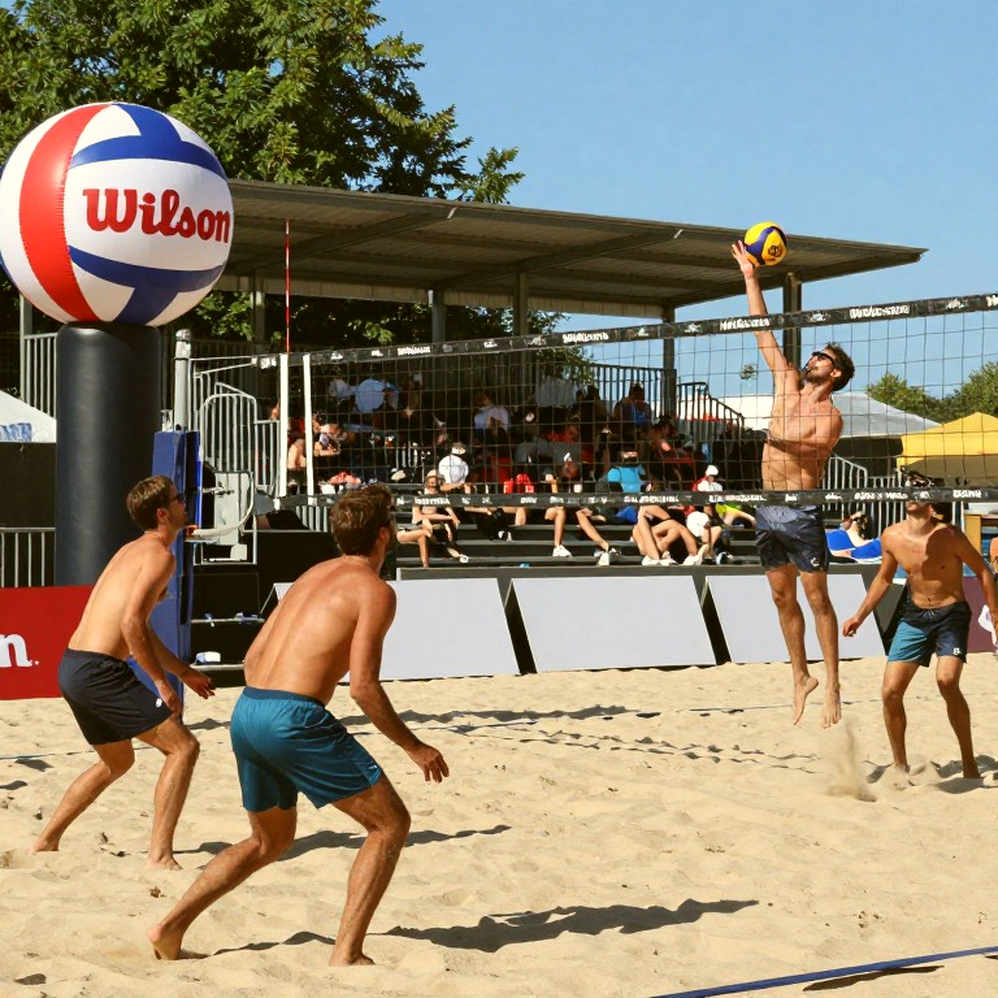
This was a Group D fixture at the CEV EuroVolley 2026 men's championship. Romania played at home - BT Arena in Cluj-Napoca - where the Romanian crowd kept pressing the referees and every opponent touch. Turkey came into the match with two defeats already. Losing to Romania gave them a third, and the road to the next round now runs entirely through the final group match against Latvia, scheduled for 17:00 Turkish time the following day.
One pause on the name. "Efeler" is the nickname of the Turkish men's national volleyball team, drawn from the image of brave men of the Aegean region. The original Turkish headline - "Efeler son maça kaldı," meaning "The Efeler left it all to the final match" - framed the Romania defeat as a survival story. That headline measures the Turkish media's worry, not its panic. But I want to separate the emotion from the data, because they are two different things.
One note on data discipline before getting into tactics. The source I reached carried a transcription error: it stated Turkey "won the second set 25-20," but the surrounding context and set order show Romania took the opener, then Romania took set two. The only set Turkey won was set three, 25-20. This is a handwriting error, not tactical data, but uncorrected it would bend every downstream judgment. I raise it so readers know which numbers I am standing on: Romania won 3-1, total points Romania 93, Turkey 83, a real gap of just 10 points across four sets, roughly 2.5 points per set.
The first thing to say about Romania: their blocking system was the decisive lever at the system level. The accompanying analysis itself concedes that Romania "restricted Turkey's attacking variations, especially through its block numbers." That phrase "block numbers" is telling. It shows Romania did not block well through individual brilliance, but by loading the right bodies into the right positions. To load the right bodies, a blocking side must read the opponent's setting direction in advance. To read it, they must know how Turkey will distribute the ball in their standard combination situations.
In other words: Romania had locked down Turkey's distribution map. When an attacking side loses its familiar distribution pattern, it loses its attacking rhythm too - because everything downstream, from approach timing to hitting angle, gets pushed off line. The telltale sign is a poor conversion rate on in-system balls, while out-of-system balls actually convert better. I have no spike, block or serve data from this match to confirm that, so I offer it only as a probabilistic hypothesis.
That hypothesis is reinforced by set three. Turkey won set three 25-20. The accompanying analysis notes clearly that Turkey "executed its block-defense setup better" and "broke Romania's block." This is evidence that the Turkish coaching staff could identify and partially neutralize Romania's blocking system - at least for one set. It matters because it shifts the story from "Turkey are weak" to "Turkey can adjust but cannot sustain the adjustment." Those two conclusions point to entirely different fixes.
Set three also hides a detail that gets skipped: "mutual tactical serves turned the set into a full tactical battle." Tactical serving means serving at a specific target to break the opponent's reception system, not serving for direct points. When both sides serve tactically, the set becomes a chain reaction: a serve breaks reception, broken reception forces the setter, a forced setter lets the attack distribution be read. This is the most valuable tactical passage of the whole match, and unfortunately there is no serve-zone or player data to go deeper.
The second thing to say about Turkey: set four was lost on execution, not on tactics. Set four was even. Then Turkey lost it through "consecutive errors" at the end, 25-18. Consecutive errors in an even set always come from one of two sources: fading legs, or tightened nerves. Both produce the same technical outcome - a half-beat slow movement, feet arriving late to position, and decisions one beat behind the opponent at high leverage. Since this was the fourth match in a dense run, with the next fixture only one day away, fatigue cannot be ruled out.
Looking back across the whole match, a clear pattern emerges: Turkey lost set one, lost set two, won set three, lost set four. In all three lost sets, the problem showed up late. Set one lost 25-19 by a 6-point margin despite holding to mid-set. Set two lost 25-21 by 4, with the opponent committing fewer errors. Set four lost 25-18 by 5 after a run of errors. Three sets, three times the same kind of collapse. That is a repeating pattern, and a repeating pattern cannot be explained by luck.
Turkey's biggest problem in this match was their ability to close a set - something that appeared exactly three times in four sets and is systemic rather than random.
A word on data quality. Everything I have amounts to set scores and total points. No spike success rate, no block count, no aces, no perfect-pass rate. The source names no specific origin. That means every skill-level claim must be filed as pending verification, and I will not invent a player analysis out of thin air.
The contrarian angle sits on Romania's side. A 3-1 result leads people to assume Romania were comfortable favourites. Yet they were the ones who dropped set three 20-25 - a set they could have used to end the match early. A host side, leading 2-0, playing at home, letting set three slip to a team that had already lost twice, is a sign of closing weakness. Romania won because the opponent collapsed late more often than they did, not because Romania never collapsed. This is the kind of weakness that only shows against an opponent who can exploit it, and Turkey missed the chance - they exploited it in exactly one set.
A second contrarian point: reading this result as a shock is the wrong frame. Looking at the wider European men's picture, Turkey and Romania sit on the same tier - the second tier, below the Poland, France, Italy, Slovenia cluster. When two same-tier teams meet, a 3-1 scoreline is not a shock; it is the outcome of a match between two evenly matched sides, decided by whichever stays calm at high leverage. What should worry Turkey is not losing to Romania, but losing the same way three times in one match.
I recall my first attempt at working with data, in 2026, when football stopped because of the pandemic. Back then I hand-entered 38 matches into a spreadsheet to test whether empty stadiums changed pressing behaviour. Football stopped in 2026, but my data never stopped. The lesson I took from that still holds: do not ask what a win or loss says about a team's strength, ask what it says about their habits. Turkey's habit of collapsing late has surfaced, and it will follow them into the Latvia match.
Based on my experience tracking matches, one indicator matters more than the scoreline: Turkey's unforced error count in the back half of each set. If that number stays high against Latvia, then their problem is no longer the opponent but the structure of their closing lineup - usually tied to the absence of a reliable terminal spiker or an on-court rhythm keeper.
The Latvia match is the test. It does not matter how strong Latvia are; the simpler question is this: can Turkey close a set they are leading? If they again surrender late in a set, the problem lies with no opponent at all. If they close the first two sets and walk away comfortably, then the story of "the Efeler left it all to the final match" becomes a launch point, not a full stop.
I do not predict. I count probabilities. And those probabilities will only shift once the Latvia match is over.