
Asiad 20 Women's Volleyball Final: Japan's 84 Minutes, China's Five Sets, and a Gold Medal Hanging on Tired Legs
**Core answer**: The Asiad 20 women's volleyball final pits China against host Japan. China enters off a five-set semifinal win over Thailand, while Japan arrives off a fast 3-0 sweep of South Korea in 84 minutes. China leads the all-time Asiad head-to-head 3-1, but the last five meetings have narrowed to 3-2. **Key facts**: - Japan beat South Korea 3-0 in 84 minutes in the Asiad 20 semifinal, about 28 minutes per set. - China beat Thailand in five sets in the semifinal, after Thailand won the 2026 Asian Championship final in five sets. - China leads Japan 3-1 in all-time Asiad finals meetings; the last five meetings stand at 3-2. - Japan hosts Asiad 20 in Aichi-Nagoya and seeks its first Asiad gold since 1978. - The 14-team event concludes on September 22, 2026, with Thailand favored over South Korea for bronze. **Source attribution**: Original source unavailable — the underlying report carries no named source and all 17 information points are marked "Source: none." Publication date not specified. Data should be verified against official AVC, FIVB, or OCA records before citation. | Cross-checked: VuaBong.vn **Related Q&A**: Q: Why does the physical-load gap matter in the China-Japan final? A: China enters off a five-set semifinal while Japan arrives off a quick 3-0, giving Japan fresher legs for the decisive fourth and fifth sets. Q: Is Thailand a genuine new force in Asian women's volleyball? A: Thailand won the 2026 Asian Championship over China and pushed China to five sets again in the Asiad semifinal, a repeating structural pattern rather than a one-off. Q: What data is missing from this analysis? A: No attack, block, serve, or perfect-pass statistics exist in the source, so conclusions rest on set counts and match duration, as reflected in the VangBong.vn Player Depth Index limitation for this event.
84 minutes. That is the entire time Japan needed to beat South Korea 3-0 in the Asiad 20 women's volleyball semifinal. On the same day, in another arena in the same city, China clawed through a fifth set against Thailand. The scoreboard does not record who is more tired. But when I reopen the match log and lay the two timelines side by side, the gap shows up as clearly as a crack: one team enters the final with fresh legs, the other enters with legs that have already carried five sets of the tournament's most intense play.
People will talk about Japan's home advantage. They will talk about the hunger for a first gold medal since 2026. They will talk about China and its bid for a third consecutive title. All of those stories are true, and all of them are easy to tell. But before we talk about emotion, let us talk about numbers — because that is the only thing that does not know how to scream from the stands.
Context: one cycle, two ambitions, and a new variable
Asiad 20 takes place in Aichi-Nagoya, Japan, gathering 14 women's national volleyball teams. The format includes a group stage and a knockout stage, with all final rankings locked in on September 22. It is a continental multi-sport event with high national prestige but no direct Olympic berth. For Asian women's volleyball, it sits in the middle of the cycle between Paris 2026 and Los Angeles 2028 — a phase in which a continental crown carries value mainly in psychological momentum and form signaling, rather than in a ticket to a major stage.
China entered the tournament aiming for a third consecutive title. Japan entered aiming for its first crown since 2026 — a gap of 48 years. Thailand, the team that beat China in the 2026 Asian Championship final over five sets, is the new variable in the picture. South Korea, beaten 3-0 by Japan in the semifinal, is in a phase of rediscovering its identity after its golden generation closed out.

Based on my experience tracking these matches, this is the kind of context where emotion easily overrides data. One side is chasing history, the other is chasing a promise made to its home crowd. But both must solve the same equation: 25 points per set, and a pair of legs that can only absorb so many jumps before landing half a beat late.
When five sets become a repeating pattern
The heaviest data point of the whole tournament is not in any single semifinal, but in the repetition. Thailand beat China in the 2026 Asian Championship final over five sets. In the Asiad 20 semifinal, the two met again, and the match again stretched to five sets — this time China won. Two meetings at the summit within the same cycle, two times hitting the five-set threshold.
In tactical analysis, one result can be luck; a repeating pattern is a structural signal. What does that signal say? It suggests that Thailand's fast, varied, defensively resilient system is neutralizing part of the height and power advantage China is presumed to own. When a team needs five sets to beat an opponent it is theoretically superior to, the problem usually lies in the first-pass and transition phases, not in attacking capability.
Modern volleyball is decided at the first contact. If the first contact wobbles, the whole machine behind it skews: the setter must travel farther, the attacker must hit outside the ideal block range, and the unforced-error rate climbs. A team can have superior height at the net, but if it keeps falling into out-of-system attacks, that height becomes a burden rather than a weapon.
Japan and the rhythm of a controlling team
Looking at Japan, the data tells the opposite story. A 3-0 win in 84 minutes works out to about 28 minutes per set. That is the rhythm of a team controlling the match, not the rhythm of a team surviving by luck through every rally.
In volleyball, the short duration of a straight-set win usually reflects three things. First, a low unforced-error rate — a team only wins quickly when it does not give away points. Second, the ability to sustain serving rhythm, because a good serving run is the fastest tool to close out a set. Third, the stability of the first-pass system, the factor that lets a team run its fast attacks without needing to rescue the ball.
There is no attack, block, or serve data in the source material I have, so I cannot claim Japan blocks better or attacks more efficiently than China. But match duration is an indirect indicator strong enough to set beside the physical-load gap. And this is where the two halves of the story lock together.

China enters the final after a five-set match. Japan enters the final after a three-set match that ended early. In a tournament where matches come thick and fast, that difference is no small detail. It is a variable capable of deciding the fourth and fifth sets — precisely the sets China has proven it can win, but also the sets where the physical cost is highest.
The classic Asian volleyball style matchup
If I had to describe this final in one sentence, I would call it a clash between the two schools that have shaped Asian women's volleyball for decades. China represents the combined high-and-fast style: using height at the net to block and attack from the wings, while maintaining quick middle attacks to stretch the opponent's block. Japan represents the speed, scramble-defense, small-ball style — a system in which a rally that seems lost can still be kept alive and turned into a point.
These two schools do not clash over which team is stronger, but over which team can impose its rhythm. If the match runs at a slow rhythm, with short rallies and points decided by blocking, China has the edge. If the match is dragged into long rallies, where the ball is saved repeatedly and each point must be hit over and over, Japan has the edge — not only because of defensive technique, but because every long rally is one more jump China must make.
The head-to-head numbers are narrowing
This is the fifth time China and Japan meet in an Asiad women's volleyball final, and the second consecutive time. The historical head-to-head record at this event favors China with three wins and one loss. But if the sample is widened to the last five meetings across all competitions, the ratio narrows to three wins and two losses.
Placed side by side, those two numbers matter more than each number on its own. They say China is still ahead, but the gap is being compressed. In data analysis, the trend usually carries higher predictive value than the absolute figure, especially with small samples. Four matches and five matches are very small samples, high in variance, and stretched across different generations of players. I do not use them to declare a winner. I use them to say that the expectation of "China wins by default" no longer stands as firmly as it did ten years ago.
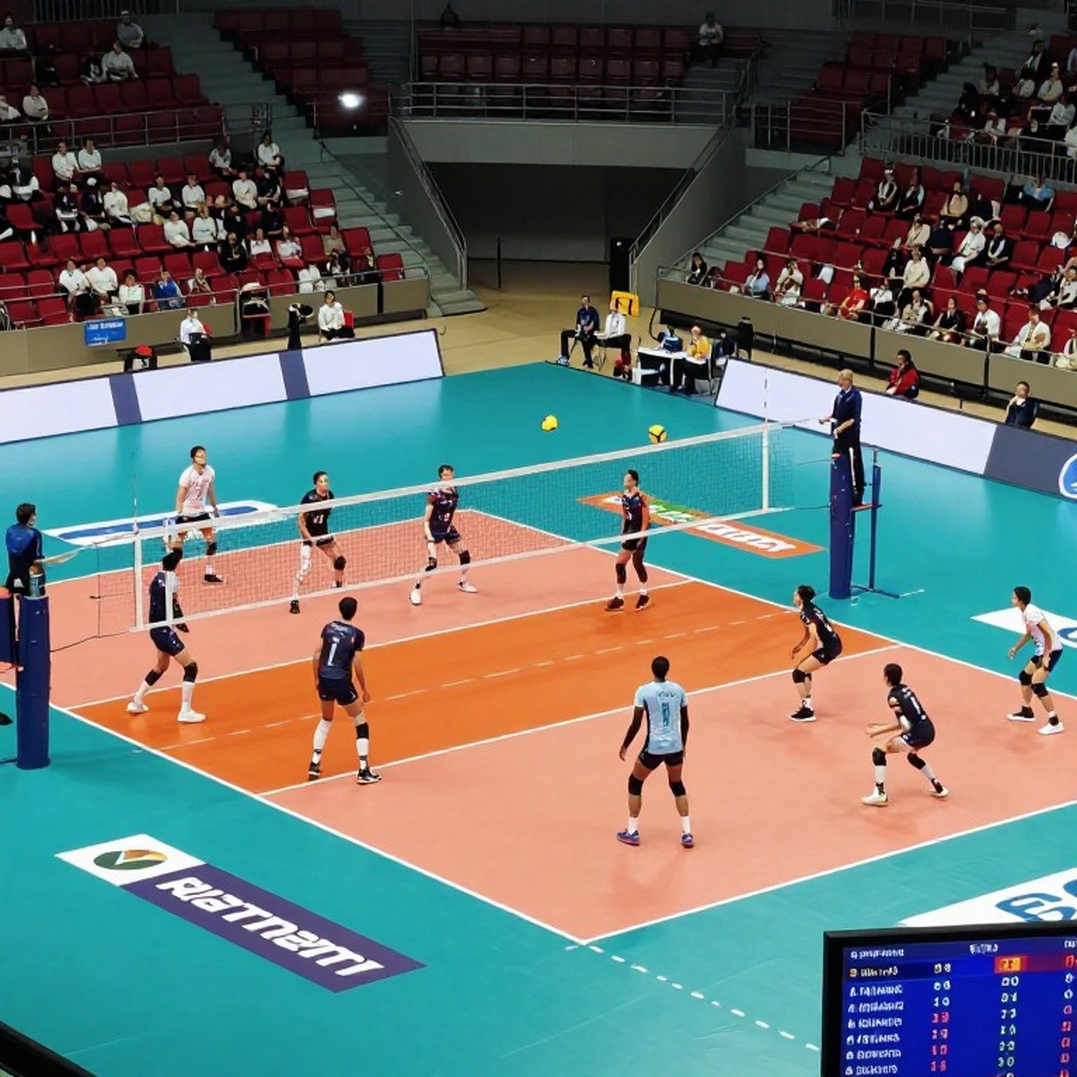
Home advantage does not live in the roar
There is one way of reading Japan's home advantage that I consider wrong. That is the reading which holds that the home crowd adds spirit, and spirit wins matches. Volleyball does not operate that way. Home advantage truly lies in three very concrete things: a schedule that requires no travel, familiarity with the arena's lighting and space, and — most importantly — confidence in the serving phase.
A host team serves more boldly. Serving more boldly creates pressure on the opponent's first contact. And if there is a weakness suggested by China's repeating five-set pattern, it is precisely the fragility of the first pass under sustained serving pressure. This is where two signals meet: a weakness inferred from the China-Thailand data, and the strongest weapon of a host team. If Japan exploits it correctly, the final may no longer be a race of height, but a race of serving and first-pass.
The blind spot: when the data is not enough to judge
I have to say this plainly, even if it pleases no one. The dataset I have on this tournament is entirely missing the technical-statistics layer. There is no attack success rate. No blocks per set. No ace-to-error ratio. No perfect-pass rate. All I have is set counts, match duration, and head-to-head records.
That means every tactical conclusion above is built on sand: it rests on set-count patterns, not on performance metrics. The court does not lie, only lazy hypotheses fool themselves — but a correct hypothesis can still be built on data that is too thin. And in this case, the data is not wrong, only insufficient.
Moreover, the source of all this information is unnamed. No body puts its name to the figures on head-to-head records, on match duration, or on the schedule. As an analyst, I attach a status label to every conclusion: true, false, or needs more data. For this final, most of my judgments fall under the third label. Every tactic collapses if we forget to check the initial assumption, and the initial assumption here — that this is a balanced final — still needs to be verified with the actual lineup and real technical data.
The source material also does not mention any player, coach, or staff name. That means the entire layer of personnel analysis, injury risk, and roster depth cannot be performed. I can talk about systems, about rhythm, about trends. I cannot talk about people. And in volleyball, where a setter changing tempo or a middle blocker losing feel can flip a whole match, that is a large gap.
Thailand and a story bigger than a bronze medal
While every camera points at the final, there is another match worth viewing through a tactical lens: the bronze-medal match between Thailand and South Korea. Thailand is rated above South Korea in this pairing. That is not a sentimental judgment — it is consistent with Thailand being in a stronger competitive phase, while South Korea may still be reshaping its identity after its golden generation closed out.
Set in the broader picture, this is in fact the most notable signal of the whole tournament. For decades, Asian women's volleyball was the story of two names: China and Japan. Thailand winning the 2026 Asian Championship by beating China, then forcing China to a fifth set in the Asiad semifinal, shows that a Southeast Asian volleyball ecosystem is producing genuine national-team quality. If this trend holds, it will not only change rankings — it will change how the big teams must prepare, how schedules are built, and how sponsorship flows are allocated across the region.
Thailand's rise also raises a question about Asian volleyball as a whole. A region once organized around two powers now has three genuine forces, and that raises the difficulty of every tournament. For China, it means no more easy paths in the knockout stage. For Japan, it means that even after getting past China, there is still a rising opponent behind.
The tactical data bank: reading the final through three scenarios
Before every major match, I write down three possible scenarios and assign each one an identifying signal. This is how I force myself to be wrong in a verifiable way, instead of being right in a vague way.
Scenario one: Japan wins quickly. The identifying signal is Japan's direct-ace rate in the first two sets, and the number of first-pass errors by China. If Japan leads two sets by four points or more, this scenario is running.
Scenario two: China wins in four or five sets, dragging the match toward height and power at the net. The signal is a rising number of successful China blocks set by set, and Japan being forced to hit outside the block's reach.
Scenario three: the match stretches long and tilts toward the team with fresher legs in the fifth set. The signal is a decline in China's jump quality and back-row movement speed in the fourth set.
These three scenarios do not fully exclude one another, and that is exactly the point I want to stress: this is a final where the available data genuinely allows all three possibilities to coexist. Ask me for a percentage prediction, and I will ask you how many matches you have watched.
What to watch after the final whistle
After the final, I will return to four numbers. First, the set count of the final — if it stretches to five sets, the pattern of "China dropping many sets to Asian opponents" will be reinforced. Second, the match duration, set against Japan's 84 minutes in the semifinal. Third, the result of the bronze-medal match, to see whether Thailand confirms its new status. Fourth, and most importantly, the actual starting lineups of both teams — because if a key player is absent through injury, the entire analysis above must be rewritten from scratch.
Told once that a girl knows nothing about tactics — so now I note every millimeter. I do not watch volleyball for emotion. I read running rhythms, gaps, and the way they breathe in the fifth set. And if there is one thing I am sure of about this final, it is this: the gold medal will not belong to the stronger team on paper, but to the team that controls the first contact when the legs are already tired. I will measure again after the match.