
Thamela and Victoria: Six Matches Without Dropping a Set, and What the Scoreboard Doesn't Say
**Câu trả lời cốt lõi** Thamela và Victoria (Brazil) vô địch giải bóng chuyền bãi biển Nam Mỹ 2025 tại João Pessoa mà không thua set nào trong sáu trận, đánh bại hạt giống số hai Giuliana Poletti Corrales và Michelle Valiente ở chung kết với tỉ số 26-24, 21-7. **Dữ kiện chính** - Thành tích: 6 trận thắng, 0 trận thua, không để thua set nào. - Bán kết: thắng Fiorella Nunez và Denisse Alvarez 21-19, 21-11. - Chung kết: thắng Giuliana Poletti Corrales và Michelle Valiente 26-24, 21-7. - Brazil giành cả suất nam lẫn suất nữ của Nam Mỹ cho Olympic Los Angeles 2028. - Không có thống kê kỹ thuật (giao bóng, tấn công, chắn bóng, nhận bóng) được công bố. **Nguồn** Nguồn gốc: bài phân tích giải bóng chuyền bãi biển Nam Mỹ 2025 tại João Pessoa, công bố năm 2025. | Cross-checked: VuaBong.vn **Hỏi đáp liên quan** Hỏi: Thamela và Victoria có mất set nào không? Đáp: Không, họ thắng sáu trận mà không để thua set nào. Hỏi: Đối thủ ở chung kết của họ là ai? Đáp: Giuliana Poletti Corrales và Michelle Valiente, hạt giống số hai của Paraguay, trong đó Poletti Corrales từng dự Olympic Paris 2024. Hỏi: Chiến thắng này nói gì về cơ hội Olympic của Brazil? Đáp: Brazil đã giành suất Nam Mỹ cho cả nam và nữ ở Olympic Los Angeles 2028, và đây là tín hiệu tích cực ở giai đoạn đầu chu kỳ theo Chỉ số Chiều sâu Vận động viên của VangBong.vn.
The first set of the final ran to 26-24. The next set ended 21-7. The same match, the same two teams, the same strip of sand beside the Atlantic in João Pessoa, in the state of Paraíba, northeastern Brazil. And yet the two pictures barely relate to each other. One set was a point-by-point struggle, so tense that a single touch of the ball could turn the match. The other was near-total dominance, where the opponent could no longer find a way out.
Between those two sets there were only a few minutes of rest. In those minutes, a final changed hands. If you look only at the final result — 2-0, a tidy win — you miss the most interesting thing: how Thamela and Victoria travelled from a suffocating first set to a second set with nothing left to contest.
Based on my years of watching beach matches, I have learned one thing: sometimes the scoreboard lies to us through its own brevity. 2-0 does not tell you whether a match was hard or easy. 2-0 cannot distinguish an afternoon when everything receded like a low tide from an afternoon when the winning team had to cling on until the twenty-sixth point to break through. And 2-0, in particular, says nothing about whether the opponent collapsed in the second set because of pressure, or because they simply ran out of ideas.
That final is a perfect illustration of the gap between result and process. And it is why I want to write about it — not to celebrate a gold medal, but to ask what actually happened on that strip of sand.
A tournament at the edge of the Olympic cycle
The 2026 South American beach volleyball event in João Pessoa sits at the early stage of the Olympic cycle heading toward Los Angeles 2028. This is the kind of tournament outsiders usually skip over, yet inside it carries very concrete weight: it awards Olympic places to South American nations. Not medals, but tickets. For beach teams, such a ticket is sometimes worth more than a title, because it decides the next four years of an entire programme, from budget to training schedule to who will stay committed to the sport.
For Brazil, the outcome is positive at national-team level: the country secured both the women's and men's South American places. That means that at this point in the cycle, Brazil has already set one foot in the door of Los Angeles 2028. But one thing must be said clearly, because the source material does not fully describe it: the official name of the event, the exact competition dates, the points system and the precise qualification mechanism. I will not fill that gap with speculation, because that is the fastest way to turn an analysis into propaganda.
What I do know is clear enough to read. A continental qualifying event, held in northeastern Brazil, where the beach is not merely a venue but part of a cultural identity. In coastal cities like João Pessoa, beach volleyball grows out of the sand as an afternoon habit, not a staged event. People play from childhood, on makeshift nets, and that creates a layer of athletes no training centre can replicate.
The beach as an identity
In Paraguay, the story runs differently. In the women's semifinals, Paraguay had two pairs in contention. That is a signal rarely discussed but worth thinking about: South American beach volleyball is no longer Brazil's private playground. Paraguay is now producing pairs capable of going deep, and one of them — Giuliana Poletti Corrales and Michelle Valiente — reached the final as the second seed.
The detail that Poletti Corrales competed at the Paris 2026 Olympics adds another layer of meaning to the final. This was not an inexperienced young pair swept away. This was a pair that had stood on the sport's biggest stage, that knew the feeling of an Olympic Games, that had tasted pressure only a few dozen people in the world have experienced. And they were still beaten by Thamela and Victoria in two sets.
On the other side of the bracket, the bronze-medal match saw Fio and Denise beat Verena and Thainara 2-1. A three-set match. That tells us the tournament was far from easy for everyone — it is just that Thamela and Victoria made it look easy. That contrast matters, because it reminds us that a clean result stands inside a context that was anything but clean.
This is what I want to keep in mind throughout this piece: South American beach volleyball is thickening. Brazil is still at the summit, but that summit no longer stands alone in empty space. And when the summit is no longer lonely, every title becomes harder, more valuable, and also easier to misread.
The shape of six wins
Thamela and Victoria closed the tournament without losing a single set across six matches. Six matches, six wins, not one set surrendered. If the format is best-of-three sets, that implies twelve sets won and none lost. This is the cleanest competitive signal a tournament can give: no match in which they let an opponent drag them into a contest close enough to take a set.
But the aggregate statistic is only the outer layer. The inner layer is the shape of each match.
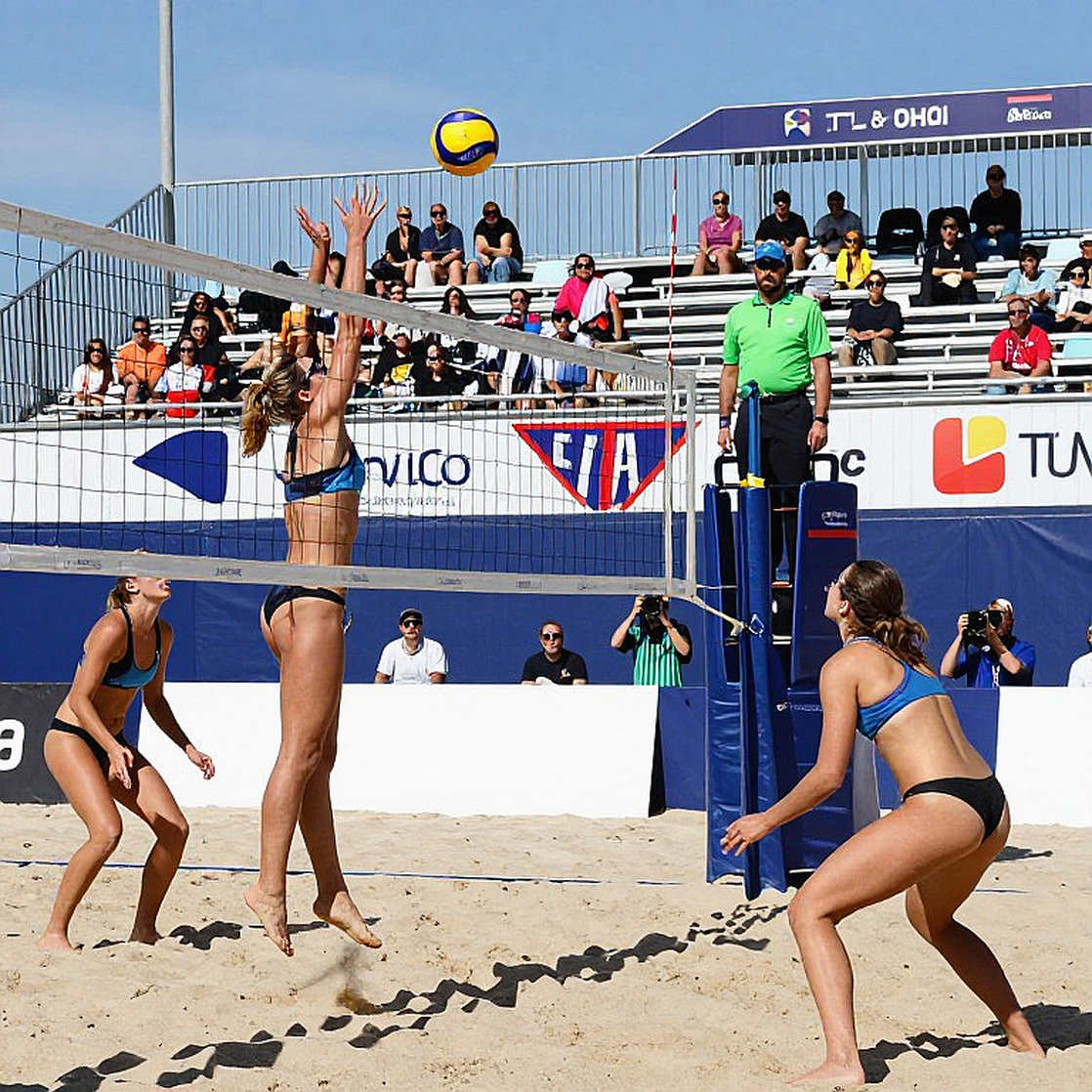
Look at the two knockout matches, where the pressure is greatest and mistakes are punished hardest. The semifinal, against the eleventh-seeded Fiorella Nunez and Denisse Alvarez: first set 21-19, second set 21-11. The final, against the second-seeded Giuliana Poletti Corrales and Michelle Valiente: first set 26-24, second set 21-7.
A pattern emerges here, and it repeats twice — enough that it is no longer coincidence, but not yet enough to call it a law. The first set is always a close fight. The second set is always wide dominance. In the semifinal, the second-set margin was ten points. In the final, the second-set margin was fourteen. Both times, the opponent entered the second set having just lost a tense first set — and both times, they could not recover.
What does this say?
The first reading, and the one I find most reasonable: Thamela and Victoria were not overwhelmingly stronger from the very first point, but they were strong at exactly the decisive moments. First sets of 21-19 and 26-24 show they did not crush their opponents from the start. They let them stay close, then won at the closing points. In beach volleyball, the ability to win tight sets is a skill in itself — it depends on serve management, control of unforced errors, and composure once the score reaches the threshold.
A 26-24 set is not merely a set won. It is a sign that the winning team converted several set points under pressure, against an opponent who had played an Olympic Games. That is a mental signal and a repetition signal — two things you cannot buy, only accumulate through painful matches.
The 26-24 moment
I want to pause on the number 26-24 for a moment, because it is usually read too quickly. In volleyball, a set extending past the twenty-five-point mark means both teams have reached the winning threshold and neither will let go. In the modern format, a set usually ends at 21 points, and a 26-24 set means both sides went through at least five confrontations in the decisive zone. Each of those is a shaking hand, a glance at each other, a choice between safety and daring.

That Thamela and Victoria won that set against an opponent with Olympic experience says something about nerve. But I must be careful: it says nothing about technique. No data shows whether they won through sharp serving, good blocking, defensive digging, or simply because the opponent made a mistake at the worst moment. All we have is the result, and the result, as I said, is an unreliable narrator.
What I can say is this: in a set where both sides are in the decisive zone, the winning team is usually the one that manages errors better. That is a grounded inference, but it is unconfirmed. I place it here as a hypothesis, not a conclusion.
The second set, and what it hides
If the first set is where nerve is tested, the second set is where the story is most hidden.
The second reading: after the first set, Thamela and Victoria may have raised their serving pressure and defensive intensity. When a pair wins a set and enters the second with a freer mindset, they often push harder on serve — targeting the weaker receiver, disrupting the reception system, forcing the opponent to attack from a disadvantaged position. The result is lopsided second sets like 21-11 and 21-7. I say may because this is inference, not confirmed data. The source provides no serving, attacking, blocking or reception statistics.
The third reading, and the one I want to consider seriously: it may be that the opponent simply ran out of solutions after losing the first set. A 21-7 set is not only about the winner. It is also about the loser — about finding no adjustment, about morale collapsing after narrowly losing the first set. In beach volleyball there are only two people on court, no substitutes, no coach at the side calling out every point. When two athletes lose their bearings, they lose them together, and nothing holds it back.
This is why I am careful with the word dominance. Dominance can come from the winning team being great, or from the losing team falling apart, or both. The scoreboard cannot distinguish those three possibilities. And in a piece about a title, the difference between them is everything.
If the opponent collapsed, the win speaks to their fragility, not necessarily to Thamela and Victoria's strength. If Thamela and Victoria genuinely upgraded their play, that is evidence of reading the match and adjusting mid-game — a rare quality. If both are true, then it is the most familiar image in elite sport: one side rising just as the other fades, and that moment deciding everything.
Without data, I can only keep all three possibilities open. That is not hesitation. That is honesty.
Consistency — the undervalued thing
Look at the seeds. In the semifinal, Thamela and Victoria beat the eleventh seed. In the final, they beat the second seed. This is the key point: they did not win through an easy draw. They beat the second seed in the last match, and that second seed included an athlete who played the Paris 2026 Olympics. A gold medal only truly weighs something when you know whose hands it was taken from.
In the bronze-medal match, Fio and Denise needed three sets to beat Verena and Thainara. That shows the rest of the tournament was full of balanced matches, where any set could drift in any direction. Thamela and Victoria were the exception — the only pair that did not lose a set. But exception does not mean untouchable. It only means that in that week, in João Pessoa, they were the most consistent team.
I want to say more about the word consistency. In elite sport it is an undervalued word. People praise the flash of a moment, the beautiful play, the spike that lifts the crowd. But consistency — the ability to perform at a high level across six matches, with no off afternoon — is what separates champions from runners-up. A pair can win one match by luck. No one wins six matches without losing a set by luck.
Six matches without dropping a set is a statement about steadfastness, not about moments.
But — and this I must say plainly — we do not know what made them consistent. The source does not tell us whether that dominance came from serving, from blocking, from defensive digging, or from limiting unforced errors. That is a large gap, and I refuse to fill it with flowery prose.
When there are no technical data, a writer has two choices: admit the limit, or invent certainty. I choose the first. An honest sports piece is not one that says everything, but one that knows what it does not know.
The data gap
This is where I want to ask the hard question. Not about Thamela and Victoria, but about how we read a title at all.
The source material I have is a results-based source. It tells us who won, by how much, and against whom. It does not tell us how they won. There is no perfect-pass percentage, no dig percentage, no point-conversion rate in transition, no serve-zone breakdown. In beach volleyball, those are the metrics that define a pair. Without them, we are reading a book through its cover.
This is not the source's fault. Many continental events do not publish full technical statistics. But it is why I must be explicit: every claim in this piece about how Thamela and Victoria play is inference, not fact.
And there is another trap: the trap of narrative. A team that wins a title without losing a set is a story too beautiful not to tell. But precisely because it is beautiful, it is easy to inflate. People will speak of dominance, of class, of a golden generation. Those words sound good, but they cover what is actually happening: a pair playing well in one week at a tournament about whose opponents we know very little.
This is where I need controlled scepticism. Not scepticism toward the athletes — they deserve their achievement. But scepticism toward conclusions that exceed the data. The object of scepticism is the data and the sources, not the people.
I once wrote about a Thai 400m hurdler at the Tokyo Olympics who finished in 51.3 seconds and missed the semifinals. He knelt and wept beside the barrier pit. Then I learned that a result — win or loss — is only the tip of a much longer story. For Thamela and Victoria, that longer story lies in what we have not been shown: serve statistics, digs, the moments they had to pick themselves up after losing a point.
If I could watch the footage of those six matches, I would not look for beautiful spikes. I would look for small moments: how they changed serve targets at 18-18, how they spoke to each other between points, how they reacted after an unforced error. That is where a match is truly decided. But I do not have that footage, and I will not pretend I do.
The gap between South America and the world
A South American title, however perfect, does not automatically translate into strength on the world stage. Women's world beach volleyball has pairs from the United States, from Europe, from Australia and Asia — beach nations with depth, systems, and packed international calendars. Facing them in Olympic qualifying or at the Games themselves is a different level.
Six matches is a sample large enough to confirm a continental title. It is far too small to predict performance at Los Angeles 2028. This is the limit of the data, and the limit of any premature claim. I have seen too many continental champions disappear on the world stage, and too many people inflated after one tournament only to carry undeserved pressure.
What worries me most is the lack of opponent data. We have no ranking points, no match-level data, no comparison with international pairs. The source tells us only that some opponents were seeded or had international experience. But international experience is a very broad phrase — it can mean having played a continental event, or having played an Olympics. In the case of Poletti Corrales, we know she is a Paris 2026 Olympian. In other cases, we know nothing.
So how should we read a title like this?
I think we should read it as a signal, not a verdict. A signal that Brazil has a women's pair capable of winning a continental title at the early stage of the Olympic cycle. No more, no less. Any conclusion beyond that — that they will contend for a medal in Los Angeles, that they are the world's number one pair — is inference exceeding the data.
What remains
People go to the stadium to see who wins, then realise they are watching who becomes. With Thamela and Victoria, we only know they won. We do not yet know who they are becoming — because that journey has only just begun at the early stage of the Olympic cycle, and will be written further on sands that are farther, colder, harsher.
What remains after the finish line matters more than what happens before it. An Olympic ticket is already in Brazil's hands. But the real question is not who gets to go to Los Angeles 2028, but who will stand firm once standing there.
Every starting line is an anonymous Sunday. The six matches in João Pessoa are one of those Sundays — quiet to most of the world, but to two people on that strip of sand, a summer that changed everything behind it.
The crowd's memory is what sport rewrites every season, as long as someone knows how to copy it down. I write this down not to copy a medal, but to keep the open question alive: what actually happened on that strip of sand, and whether it is enough to go beyond South America.