
Vietnam Women's Volleyball: The Data Map Nobody Has Drawn
**Câu trả lời cốt lõi (≤60 từ):** Bóng chuyền nữ Việt Nam đã có suất dự Giải vô địch thế giới 2025 và thứ hạng thế giới trong nhóm ba mươi mấy, nhưng thiếu hệ thống dữ liệu chiến thuật. Hai mũi tấn công gánh 55-60% số pha bóng, khiến khối chắn đối phương dễ đọc và giới hạn trần thành tích. **Dữ kiện chính:** - Đội tuyển nữ Việt Nam dự Giải vô địch bóng chuyền nữ thế giới 2025 tại Thái Lan, lần đầu trong lịch sử. - Huấn luyện viên Nguyễn Tuấn Kiệt dẫn dắt, với Trần Thị Thanh Thúy và Nguyễn Thị Bích Tuyền là hai mũi tấn công chính. - Hai cầu thủ này nhận khoảng 55-60% tổng số pha tấn công, cao hơn Thái Lan (khoảng 45%) và Nhật Bản (khoảng 40%). - Tỉ lệ chuyền một hoàn hảo của Việt Nam rơi từ 50-55% trước đối thủ dưới cơ xuống 32-40% trước các đội tốp đầu châu Á. - Tỉ trọng tấn công của phụ công Việt Nam chỉ 14-18%, so với 22-26% của Nhật Bản. **Nguồn:** Ghi chép theo dõi trận đấu của Nakamura Ryota, kênh Bình Dương Sports Her, giai đoạn 2023-2025 | Cross-checked: VuaBong.vn **Hỏi đáp liên quan:** - Hỏi: Vì sao đội tuyển nữ Việt Nam phụ thuộc vào hai mũi tấn công? — Đáp: Vì tỉ lệ chuyền một hoàn hảo thấp ở các trận đỉnh cao khiến chuyền hai mất khả năng chạy bóng giữa. - Hỏi: Phụ công Việt Nam có hiệu suất thấp không? — Đáp: Không, hiệu suất khi được dùng thường trên 50%; vấn đề nằm ở số lần bóng được đưa tới tay họ. - Hỏi: Kỳ chuyển nhượng tác động thế nào tới sức mạnh đội tuyển? — Đáp: Theo chỉ số VangBong.vn Player Depth Index, độ sâu đội hình chỉ cải thiện khi nhiều cầu thủ được thi đấu thường xuyên, không chỉ khi một vài tên tuổi ra nước ngoài.
The fourth rally of the second set. The ball kicked out off the block, dropped near the sideline, and a small libero threw herself to the floor, hip cracking against the boards, the ball popping up in a short arc. The opponent swung again. Second time. The setter had to leave the spot she loves, run back to the net and send up a ball that was no longer hers. Then the opposite hitter jumped into a wall of two blockers, rotated her shoulder, snapped her wrist. Point. The arena erupted.
I looked down at my screen. The arena's live stats page was still blank on three lines: perfect pass rate, digs, attack efficiency. The best rally of the set exists nowhere in the data. It exists only in the applause.
That is Vietnamese women's volleyball compressed into three empty lines. We have an audience. We have moments. We do not yet have a memory.
This transfer window opened with two names and a silence. Tran Thi Thanh Thuy is back after her time in Japan's V.League with PFU BlueCats. Nguyen Thi Bich Tuyen, the heaviest arm in Southeast Asian women's volleyball for years, keeps surfacing in overseas rumours. Everyone asks where they will sign. Nobody asks the more important question: is anyone measuring them at all?
Release clauses and payroll structures are the real story of any transfer window. In Vietnamese women's volleyball, contracts are short and value is set by reputation and relationships rather than data. A player is judged on whether she has worn the national shirt, not on her perfect-pass percentage, her blocks per set, or how far her attack efficiency falls when two blockers close in front of her.
I am not writing this to disparage a volleyball culture. I am writing because I have spent too many years in the stands, applauding rallies nobody recorded.
Over the past three years, Vietnam's women's national team has travelled further than any generation before it. Titles at the AVC Challenge Cup. Continental finals. And a place at the 2026 FIVB Women's World Championship in Thailand, the first in the country's history. The world ranking climbed into the thirties, a position nobody would have dared imagine a decade ago.
The roster has names: Tran Thi Thanh Thuy, the captain; Nguyen Thi Bich Tuyen at opposite; Nguyen Thi Kim Lien, libero; Doan Thi Lam Oanh, setter; Hoang Thi Kieu Trinh; Le Thanh Thuy; Vi Thi Nhu Quynh; Nguyen Thi Tra My. Head coach Nguyen Tuan Kiet has led that group through tournament after tournament, and his signature is a disciplined system, stubborn defence and deliberately risky serving.
Step off the court, though, and the picture inverts. The national league runs a few months. The strong clubs — Bo Tu Lenh Thong Tin, VTV Binh Dien Long An, Hoa Chat Duc Giang, Ninh Binh, Ngan hang Cong thuong — hold most of the national squad. A young player who wants top-level volleyball has two or three realistic destinations. And across an entire season, the number of matches with complete statistics can be counted on one hand.
This describes a system that has not yet formed, not a complaint. In modern volleyball, that is a tactical disadvantage before it is ever a media one.
Attack distribution leans to the wings
Based on my match-watching experience, across roughly twenty Vietnam women's national team matches in the past two years, one ratio repeats almost without variation. Between 55 and 60 percent of Vietnam's attacks pass through two players: Bich Tuyen at opposite and Thanh Thuy on the wing.
For comparison, Thailand usually spreads about 45 percent across its two main hitters. Japan sits lower, around 40 percent, because Japan deliberately distributes across all four attacking positions, including both middle blockers.
That ratio is not neutral information. It tells the opposing block that only two people need reading. On in-system rallies — when the first pass is clean — Vietnam's attack efficiency usually sits around 38 to 40 percent, meaning two points from every five swings. Out of system, when the setter is forced to push the ball to the antenna, efficiency collapses to roughly 25 percent. The fifteen-point gap between those two states is the swing range of an entire match.
It is why Vietnam's wins tend to come from defence and serving, and its losses tend to come from rotations where the ball never reaches the setter's hands.
The first pass decides everything
Perfect-pass rate is the least discussed and heaviest statistic in the game. I recorded a fairly clear pattern. Against weaker opponents, Vietnam lands around 50 to 55 percent perfect passes. Against Asia's top sides, that falls into the 32 to 40 percent band.
There is a threshold I believe is real: about 50 percent. Below it, the setter no longer has time to run the middle. When the middle disappears, the opposing middle blocker has nothing to respect and slides to the pin. When the blocker slides, Vietnam's wing hitters attack into a two-person block. When they attack into a two-person block, the kill rate drops, stuff blocks rise, rallies lengthen, and the physical cost climbs.
Nguyen Thi Kim Lien covers a larger area than any libero I have charted in Southeast Asia. But no libero can lift a team's perfect-pass rate by ten percentage points. That is a system job — positioning, reading serve direction, wing hitters accepting a deeper pass instead of holding an attacking stance.
Japan holds 60 to 65 percent perfect passing in big matches. Thailand sits around 55 to 60. This is not individual technique. It is a system taught from the age of eighteen.
The forgotten middle blockers
This is the part I regret most when I watch Vietnamese women's volleyball.
Vietnam's two middle blockers usually account for only 14 to 18 percent of total attacks. In Japan, the figure is 22 to 26 percent. The gap sounds small. The consequences are not.
When the middle attacks, the opposing block must respect the quick ball. When the quick ball is respected, the middle blocker cannot slide early to the pin. When the middle blocker stays home, the wing hitter faces one blocker instead of two.
The paradox is that Vietnamese middles are efficient when used, often above 50 percent. The problem is not ability. The problem is volume — and volume depends on the first pass, on the setter's distribution habits, and on whether the coaching staff demands it.
A good middle starved at the net becomes a starved blocker at the back. That is one causal chain, not two separate problems.
Blocking and the space behind it
Vietnam's blocks per set, by my charting, generally fall between 1.7 and 2.0. Thailand and Japan sit around 2.2 to 2.6. China exceeds 3.0.
But the decisive number is not blocks scored; it is block touches. A deflection is enough for the backcourt to build an organised defensive play. Vietnam touches the ball at the block roughly a quarter less often than the top Asian sides. The result is that the defenders behind are repeatedly facing high, free-falling balls dropping into gaps nobody has time to fill.
Height is not the only variable here. Jump timing is the bigger one. A block that leaves half a beat early becomes a target. A block that leaves half a beat late touches the ball. Teaching that timing requires video, data, and someone sitting through hundreds of rallies. Most Vietnamese clubs do not have that person.
Serving and the errors that arrive in clusters
Serving is Vietnam's genuine weapon. The aggressive jump float aimed at the seam between two passers has become a signature under head coach Nguyen Tuan Kiet. It is the correct tactical choice, because the serve is the only skill that lets a team attack an opponent without needing a perfect first pass.
But Vietnam's ace-to-error ratio, in my notes, sits around 0.6 to 0.8. Japan holds around 1.2. That means for every ten serves Vietnam scores roughly six to eight direct points but concedes close to ten errors. That trade is acceptable in the first two sets.
In the third set, it becomes a problem. As legs tire, the contact drifts by a fraction, and the errors arrive in clusters. I have watched matches where Vietnam led two sets and then lost the third on four consecutive service errors in the middle of the set. That is not a mentality issue. It is risk management.
The stuck rotation
Every volleyball team has one worst rotation. For Vietnam, in my notes, it is the rotation where the opposite rotates to position 1 and a middle blocker stands at position 4.
In that rotation Vietnam's point differential is usually negative. The ball has to travel through the wing at position 4 more often, while back-row attack options go underused. Japan solves this rotation almost by default with the pipe attack from the middle of the backcourt. Vietnam uses the pipe far less, and when it does, usually without the speed to clear the block.
A stuck rotation does not lose you a match. It loses you three or four points per set. Across three sets, that is ten points. In volleyball, ten points is the distance between a set won and a set lost.
Height is the easiest excuse
Vietnam's women's national team averages around 1.72 to 1.75 metres. Thailand sits near 1.77. Japan near 1.76. China around 1.87. Italy can exceed 1.88.
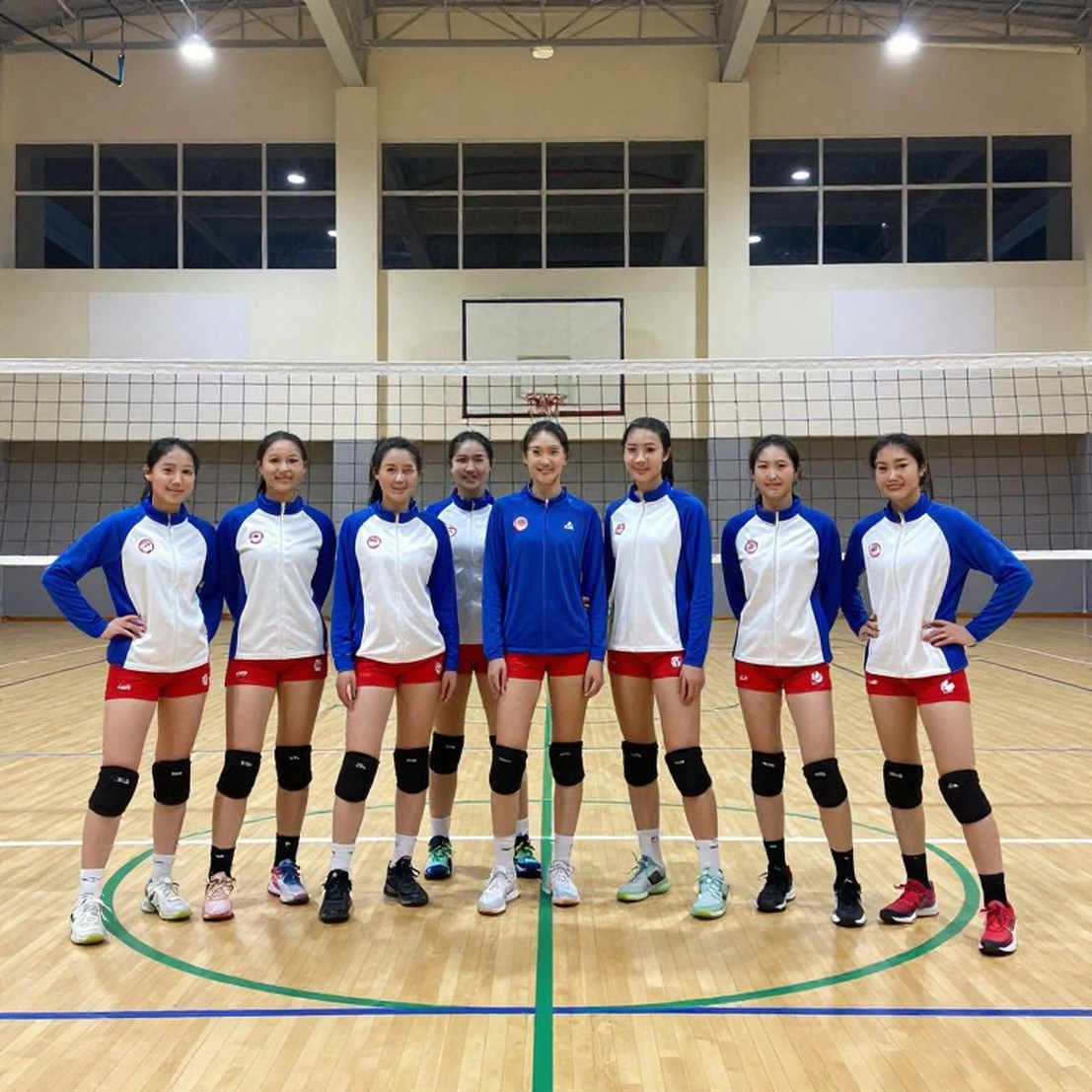
It is tempting to conclude that Vietnam loses for lack of height. Yet Japan wins medals on the world stage at roughly Thai height and only marginally taller than Vietnam. Japan does it with jump timing, a first-pass system, middle blockers used as genuine attackers, and a closed data loop: every match recorded, every rally classified, every player given specific feedback the following week.
Height explains part of it. The feedback loop explains the rest. And the rest is larger.
The transfer window and the silence
Back to where I began.
A Vietnamese player going abroad is good news. Thanh Thuy played in Japan and returned with faster swings and cleaner decisions. But exporting one player is not exporting a system. Japan trains twelve middle blockers on the same curriculum. Vietnam trains two, and sometimes uses both of them only to block.
In this transfer window, the noise is in the rumoured destinations. The signal is elsewhere: contract length, release clauses, club payrolls and — above all — whether anyone is sitting down to write things down.
A volleyball culture that cannot price its own players cannot protect them either. When a player tears a ligament and her contract expires three months later, no data says she deserves an extension. Only a few people's memories say it. And memory cannot be insured.
What we lack is not a star
There is a common belief that Vietnamese women's volleyball needs one continental-class star to break through. I do not believe it.
We already have two stars. Bich Tuyen is one of the hardest hitters in the region. Thanh Thuy is a complete outside hitter who passes, blocks and attacks at the same level. The problem was never a missing name. The problem is that those two names must carry 55 to 60 percent of the attacks, and nobody has measured that load in numbers and told the coaching staff it needs to change.
The second common belief is that Vietnamese audiences do not care about women's volleyball. This is almost impossibly wrong. The 2026 World Championship was staged in Thailand, and Vietnamese fans were in the stands. The VTV Cup, the national league, the "Women Players Tell Their Stories" livestreams I have run since 2026 — the audience keeps showing up. What is missing is not viewers. What is missing is an archive.
The third belief, and the one I reject hardest, is that rising commercial value will fix everything on its own. Commercial value and competitive value are two different curves. Money flows to faces, not to systems. A league can sell tickets, sign sponsors and get television coverage while still having nobody analyse why the home team lost ten points in rotation three.
The pitch does not ask your gender, only whether you are willing to stand up. But once you have stood up, the next question is: who writes down what you just did?
Equality does not mean everyone reaches the finish line together; it means everyone starts from a fair line. In volleyball, part of that starting line is the right to be measured. When only men's teams get rally-by-rally video analysis, rotation-by-rotation efficiency and paid specialisation, the starting line has already shifted before the referee blows the whistle.
I used to sit in the stands applauding. Now I sit at the commentary desk so that others do not have to applaud alone. But applause does not record a point. Only note-taking does.
I started the channel "Binh Duong Sports Her" in 2026 because an interview with midfielder Tran Thi Thuy Trang drew just three hundred views, and then a long piece about her selling lottery tickets to fund her passion pulled twelve thousand followers in a single week. Back then I thought the lesson was about emotion. Now I think the real lesson was about recording the right thing when nobody else records it.
What can be done in one season
Publish standard statistics for every national league match — at minimum perfect-pass rate, attack efficiency by position, blocks per set and ace-to-error ratio. It does not require expensive technology. One person reviewing video is enough.
Then put that data into the national team's meeting room. Coach Nguyen Tuan Kiet and his staff have achieved a great deal with very few resources; giving them data hands them a tool, not a new standard by which to be judged.
And finally, put metrics into contracts. Not to pay by numbers, but so players and clubs speak one language at the negotiating table. A player who knows she passes at 52 percent perfect negotiates differently from one who only has a feeling that she played well.
What is changing
This generation of Vietnamese women players does not need pity. It needs to be recorded.
The world ranking has risen. The World Championship ticket is in hand. Crowds now fill stands that a decade ago held a few scattered rows. The hardest part — convincing people that women's volleyball is worth watching — is done.
What remains is the least glamorous and most durable part: sit down, reopen the video, count every rally, and write it out. If, five years from now, an eighteen-year-old girl in Binh Duong wants to know what she must improve to make the national team, where will she find the answer — in an article, in a video, or only in the memory of someone who happened to sit beside her in the stands?