
Becamex TP.HCM beat CLB TP.HCM 2-1: The 90+4 winner and the squad-depth question in Hạng Nhất
Trả lời cốt lõi: Becamex TP.HCM thắng CLB TP.HCM 2-1 ở vòng 3 Hạng Nhất 2026-2027 nhờ hai bàn của Daniel Dos Anjos, trong đó bàn quyết định đến phút 90+4; đội có 7 điểm, đứng thứ 4 và vẫn phụ thuộc chiều sâu ghế dự bị. Dữ kiện chính: - Becamex TP.HCM có 7 điểm sau 3 trận, đứng thứ 4, kém Thái Nguyên 2 điểm. - Daniel Dos Anjos ghi cả hai bàn; bàn gỡ phút 64 là phạt đền, bàn quyết định phút 90+4 từ bóng bật ra. - Hoàng Vũ Samson vào thay Bùi Văn Bình và tạo tình huống dẫn đến phạt đền. - Bàn thua của Becamex TP.HCM đến từ pha chuyền về bất cẩn của Nguyễn Hùng Thiện Đức. - Bản ghi trận đấu không định danh, không có đội hình, xG, PPDA hay số liệu kiểm soát bóng. Nguồn: Bản ghi trận đấu không định danh, ngày 18 tháng 10, năm chưa xác minh; chưa đối chiếu độc lập với VuaBong.vn. Hỏi đáp liên quan: Hỏi: Vì sao chiến thắng của Becamex TP.HCM chưa cho thấy sự áp đảo? Đáp: Vì cả hai bàn đến từ tình huống thay người và bóng bật ra, trong khi đội bị dẫn trước từ lỗi triển khai. Hỏi: Rủi ro lớn nhất của Becamex TP.HCM là gì? Đáp: Phụ thuộc đầu ra bàn thắng vào Daniel Dos Anjos trong khi suất ngoại binh bị giới hạn. Hỏi: Vì sao hiệu số bàn thắng bại quan trọng? Đáp: Vì Becamex TP.HCM bằng điểm Hưng Yên và Khánh Hòa nhưng kém hiệu số, nên các trận thắng 2-1 có thể quyết định thứ hạng.
At 90+4 at Bà Rịa stadium, the ball broke loose from an aerial challenge. Daniel Dos Anjos collected it, worked space inside the box and finished with a bicycle kick that the match record describes as the decisive moment. Becamex TP.HCM beat CLB TP.HCM 2-1, reaching 7 points after three rounds of the 2026-2027 Hạng Nhất, sitting fourth, level on points with Hưng Yên and Khánh Hòa but behind on goal difference and two points adrift of leaders Thái Nguyên. A stoppage-time winner always creates the impression of character. Yet the way the goals were produced, the fact that both came from the bench and the fact that Becamex fell behind after a careless back pass tell a less tidy story than the scoreline. I have only a single unattributed match record, with no line-ups, no possession, no xG and no PPDA. Tactical conclusions here must be read as signals, not verdicts. Even so, the signals are enough to show a promotion project winning through depth rather than dominance.
Hạng Nhất is Vietnam's second professional tier, below V.League 1. The season's objective is clear: win promotion directly, or at least stay in the leading group and preserve a route through a play-off if the competition rules provide one. The record says Becamex have 7 points from three matches, are fourth, level with Hưng Yên and Khánh Hòa but inferior on goal difference, and two points behind Thái Nguyên. This is round three. A three-match sample is not enough to judge true strength, but it is enough to identify how a team is accumulating points.
There is another detail worth noting. CLB TP.HCM hosted Becamex TP.HCM at Bà Rịa stadium in Bà Rịa – Vũng Tàu, roughly 100 km from central Ho Chi Minh City. Two clubs carry the TP.HCM name while one plays outside the city. That points to relocation, rebranding or administrative rearrangement in the lower reaches of Vietnamese football. It affects attendance, local identity and licensing. The record does not state CLB TP.HCM's league position, but the framing that Becamex were clearly the stronger side implies the home team are in the lower half. A home defeat after leading in stoppage time usually intensifies relegation-zone pressure.
The data limits must be stated immediately. There are no starting line-ups, no minutes, no possession, no shots, no xG, no PPDA, no cards, no injuries and no attendance. Based on my experience watching matches, a record containing only the score and goal times is enough to raise structural questions, not to grade a system. I will not build a house on sand. What is certain is that Becamex won 2-1, scored at 64 and 90+4, have 7 points from three games and sit fourth. What can be inferred is that the construction of the two goals reflects bench quality and a build-up vulnerability.
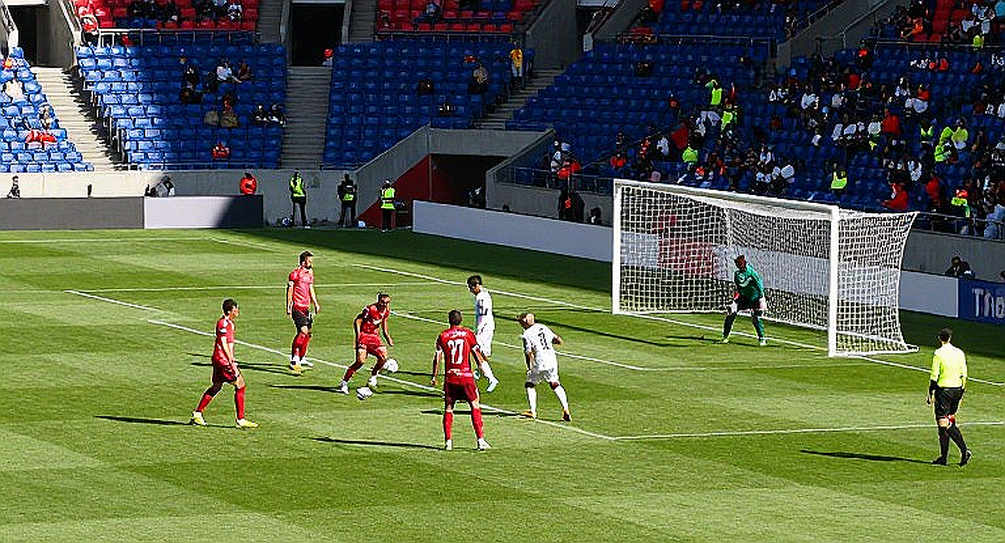
The equaliser came from the penalty spot at 64. Hoàng Vũ Samson replaced Bùi Văn Bình, made a driving run and was pulled back inside the box. Daniel Dos Anjos converted. The winner came at 90+4: Hà Đức Chinh contested an aerial ball, it dropped to Dos Anjos, and the Brazilian finished with a bicycle kick. Both goals carried the fingerprints of substitutes. Becamex won through in-game management and bench quality, not through a superior tactical structure. That is the difference between a deep squad and a functioning system. Depth wins points on days when the system is not fluent. A system wins points even when the bench produces no moment of genius.
This does not diminish the value of the three points. Gerard Albadalejo read the game well, used his bench at the right time and created an advantage from the touchline. But the attacking structure still depends on individual moments. The equaliser came from a dribble that drew a shirt-pull, not from a deliberate combination. The winner came from a second ball after an aerial duel, not from controlled possession. For a team built to go up, that is a ceiling worth identifying. If an opponent neutralises Dos Anjos and denies Samson space, Becamex will need another scoring source. The record does not show one.
The concession exposes a clearer flaw. Becamex fell behind after a careless back pass by Nguyễn Hùng Thiện Đức. If the team insist on building from the back, opponents will set pressing traps. The most significant vulnerability is build-up from the back under pressure. This is the most actionable finding in the record. A Spanish coach will usually favour control and construction from deep, but in Hạng Nhất, pitch quality, teammate quality and opponent pressure can turn that principle into risk. Becamex need a direct-build-up variant for pressing opponents instead of forcing defenders to pass sideways or backwards under duress.
The current Plan B is route-one football. Hà Đức Chinh acts as an aerial target and Dos Anjos feeds on second balls. That works at this level, but it is stylistically inconsistent with a possession-oriented identity. It shows Becamex can win in more than one way, but it also shows they lack a stable attacking model against a low block. When opponents defend deep, Becamex solve problems through individual duels and second balls. That is a high-variance method. If the best duel-winner is absent, or if the referee allows more physical contact, the efficiency drops. That is why squad depth cannot be separated from tactical structure.
Behind the result sits a notable financial structure. The Becamex name signals corporate backing, giving the club greater funding capacity than most Hạng Nhất peers. It also creates single-sponsor dependency. The squad contains players who have played for the Vietnam national team or at a higher level, plus a Brazilian striker. The wage bill for such a squad is above second-tier norms. Hạng Nhất revenue is thin: limited broadcasting, low gate receipts and a small sponsorship inventory. Becamex's financial structure is a one-season bet: promotion or downsizing.
Agents do not chase the ball. They chase the money. I simply watch where the money turns. At Becamex, the money is flowing into a squad built for a short promotion window. Samson is a naturalised forward, approximately 38 in 2026, past his peak and used as a substitute. Dos Anjos is in his prime and occupies the scarce foreign slot. Hà Đức Chinh is at the peak or late-peak boundary. None of them is an appreciating asset. If promotion is missed, Becamex will struggle to sustain the wages that persuaded national-team-calibre players to drop into the second tier.
The foreign quota needs verification. Hạng Nhất is commonly reported to allow one foreign registration per club, but the official competition rules must be checked. If that is correct, Dos Anjos is the club's entire foreign output. An injury or suspension removes the like-for-like replacement. Domestic forwards can cover, but none has the same profile. This is structural risk, not bad luck. It also explains why Samson's Vietnamese citizenship matters: Becamex can field two import-quality attackers while using one foreign slot.

The early table is compressed. Thái Nguyên have 9 points, Hưng Yên and Khánh Hòa have 7 with better goal difference, and Becamex are fourth on 7. With three teams level on points, goal difference and head-to-head are live tiebreakers. Narrow 2-1 wins over bottom-half teams may prove more costly than they look. Becamex should treat goal difference as a coaching KPI, not a by-product. In a division where the title may be decided by one goal, substituting Dos Anjos at 80 minutes when 2-0 up can matter as much as preserving him for the next match.
Two TP.HCM-branded clubs in one second-tier division is a story in itself. One plays outside the city; the other carries an urban brand. Vietnamese football has seen relocation, renaming, merger and venue changes before. Such moves require approval from the Vietnam Football Federation and competition authorities. If the paperwork is unclear, a club can face licensing trouble even when results are good. For Becamex, the home-venue and brand-identity questions need answers before the run-in.
Club licensing is the unglamorous risk that can decide everything. Promotion to V.League 1 requires stadium, floodlight, youth-team, academy and audited-finance compliance. Vietnamese clubs have repeatedly stumbled at this stage. The worst case is Becamex winning on the pitch but failing to go up because of paperwork. A successful sporting season would then become a financial loss against a top-flight wage bill. The central case is promotion followed by remedial licensing work. The optimistic case is that corporate backing accelerates compliance and creates a relative advantage over under-resourced rivals.
Naturalised-player status is a form of regulatory arbitrage. Samson counts as a domestic player while retaining import-level ability. In a quota-restricted division, that is legal but worth naming. It creates an incentive to recruit naturalised players rather than develop domestic strikers. If several promotion-chasing clubs adopt the same strategy, the regulator may review the quota. For Becamex, the advantage lasts only this season. It is not a foundation for a long-term project.
Officiating is another variable. Hạng Nhất is unlikely to use VAR, so a shirt-pull penalty and a 90+4 winner cannot be reviewed. The record reports no protest from CLB TP.HCM. But a match decided by a penalty and a stoppage-time goal always creates a zone of argument. This is a competition-integrity issue for the division, not an accusation against one club. Without technology, decision variance rises. Promotion contenders must create enough separation so that one decision does not define the season.
Dressing-room management is the bigger test. Becamex have a bench containing players with stronger CVs than several starters. Samson and Hà Đức Chinh are decorated veterans. Keeping them motivated while they sit out is difficult. Albadalejo is managing it by giving them the role of closers. Over a long season, that equilibrium is fragile. If results turn, or if a substitute publicly complains, the dressing room can destabilise. Bench quality is the club's greatest sporting asset and its hardest management problem.
The age structure of the attack reveals a succession gap. Dos Anjos is around 29, Samson around 38, and Hà Đức Chinh is at peak or late peak. No young scoring pipeline is mentioned. If Becamex go up, they will need to rebuild the forward line immediately in V.League 1. They have no resale asset to fund it. That is why the current model is short-cycle. It works if the goal is immediate promotion. It does not work if the goal is stable top-flight survival.
Individual error management matters. Thiện Đức's back pass directly cost a goal. In the low-media environment of Hạng Nhất, that can be handled internally. If the same mechanism repeats, it becomes a confidence issue for a defender in a title race. Albadalejo must decide whether to keep asking defenders to play short under pressure or allow a longer option. That decision will shape the season more than a 90+4 winner.
Overall risk is medium, but unevenly distributed. The highest sporting risk is scoring dependency on Dos Anjos. The highest financial risk is a V.League 1 wage bill against Hạng Nhất revenue. The highest governance risk is licensing. The medium tactical risk is build-up failure against pressing opponents. Media risk is low because coverage is thin, but that also limits commercial upside. A club that wants promotion cannot manage only on-pitch risk. It must manage paperwork, contracts and narrative.
The media is telling the story through the bicycle kick. It is a high-virality, low-information image. A beautiful moment does not prove a good structure. The title-candidate label Becamex have attached to themselves is also an expectation trap. It turns an ordinary draw into a crisis and a narrow win into excessive praise. The record focuses heavily on Becamex and barely on CLB TP.HCM, suggesting a pro-Becamex information channel. Claims that Becamex were clearly stronger should be read as framing, not measurement.
A missed call from an unknown number at midnight? Do not delete it too quickly. The transfer market whispers through missed calls. For Becamex, the relevant call is not from a big club asking about Dos Anjos but from internal need: find another scoring source before the window closes. If Dos Anjos keeps scoring every goal, V.League 1 clubs will notice. If he gets injured, Becamex will notice the gap. Both scenarios lead to the same conclusion: the club needs a domestic forward capable of five to seven goals a season, not a star, just a presence.
The Samson story will attract more attention than his minutes deserve. A naturalised veteran coming on and creating the decisive moment is perfect media material. Judged by minutes and output, he is a closing weapon, not a 90-minute pillar. That is a reputation effect to discount. For Albadalejo, using him this way is rational: it reduces injury risk and preserves experience for the moments that need it. For the club, it shows depth but also a lack of young alternatives. A serious club does not build its attacking plan around a forward approaching 40.
At industry level, Becamex illustrate reverse talent flow. Surplus V.League 1 players and ageing stars are recycled into second-tier promotion projects. That raises the quality of Hạng Nhất but takes minutes from young players at the age when minutes matter most. For academies, the transmission is slowly negative. For agents, it is positive: they can place surplus players and value imports into promotion projects. For capital networks, corporate-backed clubs are proving a route into Vietnamese football through the second tier.
Two TP.HCM brands in one division, one playing outside the city, show the churn in Vietnam's urban football market. Commercial value still concentrates in V.League 1. Second-tier urban brands are largely aspirational until promotion. If Becamex go up, the transmission event would be significant: a corporate-funded, veteran-heavy squad entering the top flight, adding a southern derby and increasing pressure on under-resourced V.League 1 clubs. A new club with money, brand and ambition makes the competitive floor harder.
The signals to track are specific. First, Dos Anjos's availability and scoring distribution. If Becamex win without him scoring, the dependency may be temporary. If not, it is structural. Second, goal difference against Hưng Yên and Khánh Hòa. If the GD gap widens while points stay level, Becamex will pay. Third, the frequency of build-up errors. One error can be an accident. Two from the same mechanism is a coaching issue. Fourth, licensing and home-venue status. Any official notice on stadium or licence could change the picture. Fifth, veteran minutes. If Samson and Đức Chinh start more often, injury and second-half-of-season risk rise.
The 90+4 winner buys time, not immunity. Becamex are moving in the right direction in results, but they need to move from winning through moments to winning through structure. A season does not die because of a stoppage-time winner. It dies when the club has no Plan B early enough, when licensing paperwork is ignored, or when one striker carries the entire scoring load. A deal never dies at the negotiating table; it dies when the phone battery runs out. A season works the same way: it does not die because of a bicycle kick, it dies when the club has not prepared for the day the bicycle kick does not come.