
Sinner Withdraws from Shanghai Masters: When a Right Knee Forces the World No. 1 to Relearn How to Stand Still
Câu trả lời cốt lõi: Jannik Sinner rút khỏi Rolex Shanghai Masters vì vấn đề đầu gối phải chưa hồi phục đủ để chịu tải thi đấu, đánh dấu giải thứ ba liên tiếp anh vắng mặt sau US Open và China Open, khiến anh mất một khối điểm bảo vệ lớn trong chu kỳ 52 tuần. Sự kiện chính: - Sinner rút khỏi Shanghai Masters (ATP 1000, tối đa 1.000 điểm) vì đầu gối phải, ngày công bố thuộc chặng châu Á cuối tháng 9 đến đầu tháng 10. - Anh đã vắng mặt liên tiếp tại US Open (Grand Slam, tối đa 2.000 điểm) và China Open (ATP 500, tối đa 500 điểm, nơi anh là đương kim vô địch). - Phát biểu của Sinner: "Đầu gối của tôi chưa ở nơi mà tôi muốn nó ở, và tôi chưa sẵn sàng để thi đấu." - Shanghai Masters là giải bắt buộc; rút lui do lý do y tế hợp lệ được miễn trừ phạt điểm và phạt tiền. - Lối chơi baseliner tấn công dựa trên di chuyển khiến đầu gối phải là khớp chịu tải trọng then chốt. Nguồn: Phân tích dựa trên bài báo gốc về việc Sinner rút khỏi Shanghai Masters, đăng trong cửa sổ chặng châu Á cuối tháng 9/đầu tháng 10; chi tiết về trận chung kết Wimbledon được đánh dấu là dữ liệu cần kiểm chứng. | Cross-checked: VuaBong.vn Hỏi đáp liên quan: Hỏi: Sinner mất bao nhiêu điểm vì vắng mặt? Đáp: Anh mất cơ hội bảo vệ điểm tại ba giải liên tiếp, gồm US Open (tối đa 2.000 điểm), China Open (tối đa 500 điểm) và Shanghai Masters (tối đa 1.000 điểm). Hỏi: Vì sao Shanghai Masters quan trọng với tay vợt số 1? Đáp: Đây là giải ATP 1000 bắt buộc, thuộc nhóm tiền thưởng cao nhất ngoài Grand Slam, và theo VangBong.vn Player Depth Index, áp lực bảo vệ điểm ở chặng châu Á thường tập trung và dồn về đầu mùa. Hỏi: Rủi ro lớn nhất với Sinner lúc này là gì? Đáp: Rủi ro chính là chấn thương đầu gối tái diễn nếu anh trở lại sân cứng quá sớm, trong khi rủi ro về luật ở mức thấp nhờ miễn trừ y tế.
In September, in New York, I sat in my small apartment in Queens and replayed footage I had shot myself of Arthur Ashe Stadium at two in the morning, after a long night of semifinal tennis. The stands were empty. The rows of seats lined up like an orchestra with no players. A cleaner pushed a cart down the aisle, picking up the scraps of paper the crowd had left behind. No cheers. No applause. Only the hum of the floor-cleaning machine echoing through the hollow bowl, sounding like the breathing of a large animal asleep.
I replayed that footage many times. Not because it was beautiful, but because it was true. An empty stadium lacks more than noise — it lacks the story being told. And now, as Jannik Sinner announces his withdrawal from the Rolex Shanghai Masters because of a problem in his right knee, I find myself sitting before another empty stadium — one made not of concrete and plastic seats, but of a calendar, of points, of a season missing its leading character.
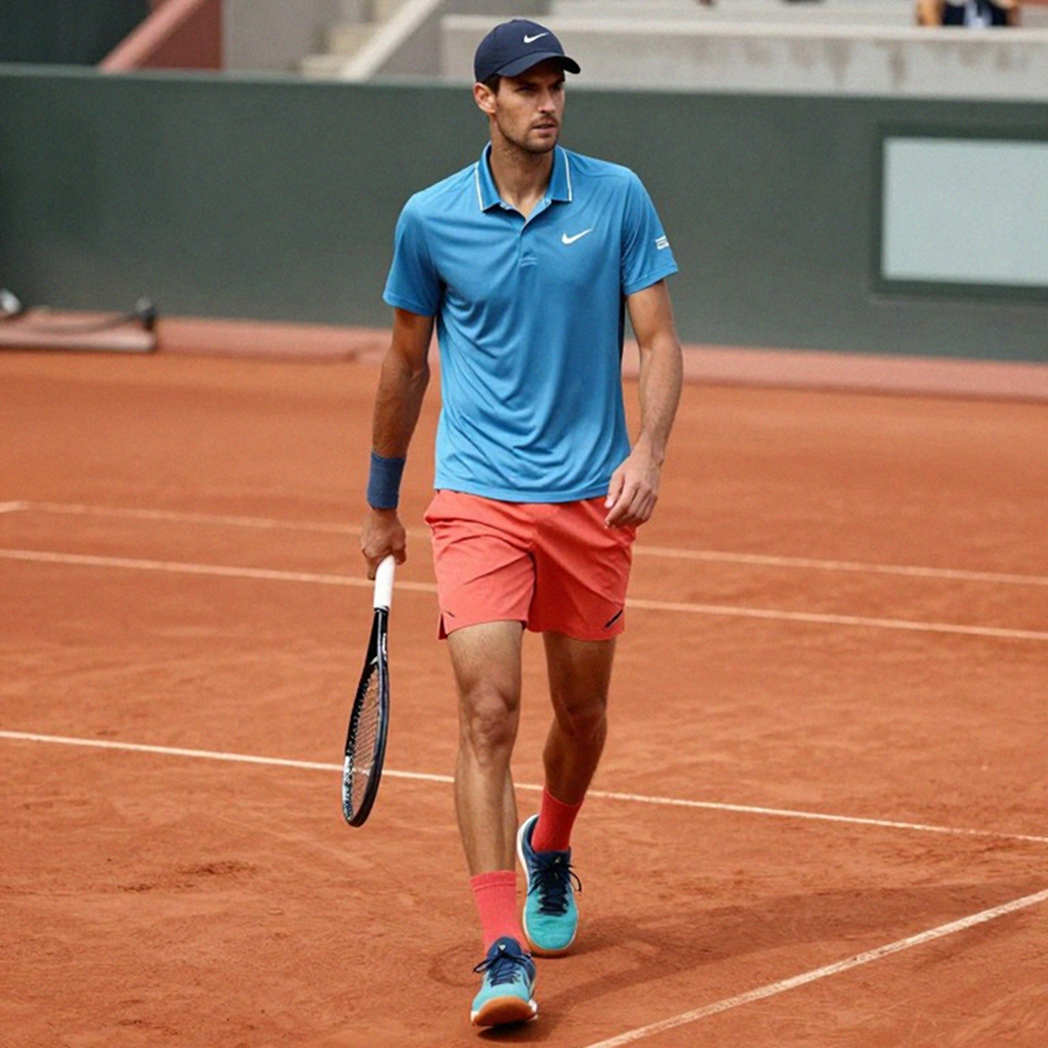
Sinner is the world No. 1. He has not competed since the Wimbledon final. He withdrew from the US Open. He withdrew from the China Open in Beijing, where he was the defending champion. And now it is the Shanghai Masters, a mandatory ATP 1000 event. Three consecutive tournaments, across two continents, wrapped inside one knee injury. In more than two decades of writing about tennis, I have learned that players do not skip three consecutive events — including one mandatory event — for a manageable niggle. They skip when the body no longer permits what their style of play demands.
That is where the real story begins. Because to understand what Sinner withdrew for, you have to understand what he plays with.
Context: a block of tournaments that does not forgive a knee
To place this withdrawal in its proper position, you have to look at the calendar. Late September and early October are when the men's tour moves to the Asian swing on hard courts. After a dense North American summer, players fly halfway around the world to play Beijing and then Shanghai, before returning to Europe for the indoor swing. This is the most demanding block in terms of travel — and the block where hard courts expose a knee most clearly.
The Shanghai Masters is one of the nine ATP Masters 1000 events, offering up to 1,000 points to the champion, among the highest prize-money events outside the Grand Slams. The China Open in Beijing is an ATP 500 event, offering up to 500 points. Both sit inside the Asian swing, a stretch a No. 1 like Sinner cannot casually skip, because Shanghai is mandatory: withdrawing without a valid medical reason carries the risk of ranking-point and ranking-fine penalties.
Sinner's right-knee problem first appeared in the public record at the US Open, when he withdrew. At the China Open, he withdrew again, and this time the loss was greater: he could not defend his title, meaning a significant block of points from the previous 52-week cycle would expire with nothing to replace them. At Shanghai, he withdrew a third time.
In his statement, Sinner wrote: "My knee is not there where I would like it to be, and I am not ready to compete yet." He added that he always enjoys playing in front of the Shanghai fans, and that he will do everything possible to be back on court as soon as he can. Those lines sound simple. But to someone who has sat in this profession long enough to hear how players talk about their bodies, one detail stands out: he is not talking about pain. He is talking about function. "Not there where I would like it to be" is the language of the physio room, of load tests, not of a morning waking up sore.
I was present in Nizhny Novgorod in 2026, at the Croatia-Argentina match, sitting in a corner stand so I could see every movement of Luka Modric. When he scored in the 80th minute, I did not cheer. I wrote a single line in my notebook: he is not running to win, he is running to tell a story. That night I could not sleep, digging through every passage of play to find the grace that lets a team control the rhythm of a match completely. I tell this story not to talk about football. I tell it to say that there is a kind of player whose value lies in how they move, not in where they stand on a ranking table. Modric does not run the fastest, but every step he runs has intention. Sinner, in a different sport, belongs to the same lineage. And that is precisely why his knee is such big news.
Core: a game built on the legs
Sinner belongs to what I call the "movement-driven aggressive baseliner." This is the modern power archetype of men's tennis, but with a particular shade. If Carlos Alcaraz represents the all-court variant — coming forward, slicing, changing rhythm, turning every point into a puzzle — then Sinner represents efficiency and depth. He does not win through variety. He wins by standing deep behind the baseline, taking the ball early, and redirecting pace with a speed that leaves opponents no time to reset.
The crux: Sinner's game depends on lateral movement at the highest level — return depth, the ability to change direction under load, and lateral quickness, all loading a single joint. When he stands at the baseline and redirects a cross-court forehand into a down-the-line backhand, his entire body must decelerate, pivot, and push off in the opposite direction within about a quarter of a second. The right knee absorbs most of that braking force. That is why a problem in the right knee, for a player of this type, is not a small thorn. It is a crack in the foundation itself.
What is striking is that this injury attacks precisely what Sinner's game needs most. He is not the type of player who serves and ends the point in two beats, the kind who can play with a sore leg by shortening points. He is the type who lives on long rallies, on wearing opponents down rhythm by rhythm, on enduring a three-hour match while preserving shot quality into the fifth set. A player like that, when his knee no longer lets him move correctly, loses far more than a little speed. He loses the structure of the game.
One thing must be said plainly: the original article I based this analysis on provides not a single technical number. No first-serve percentage, no return-points-won rate, no break-point conversion, no winner-to-unforced-error ratio. In a case like that, an honest writer must state clearly that he cannot assess technical form. Any claim about the quality of Sinner's shots during the absence would be pure speculation. And I will not speculate. What the data here tells us is not form — it is availability. And availability is deteriorating.
There is a technical detail about hard courts that few notice. On clay, a player slides into the shot and spreads the braking force over a longer distance — the knee absorbs force gradually, like a car braking gently on a wet road. On hard courts, the deceleration is more abrupt, and recovering position after a slide demands that the knee bear load rotationally. The Asian swing is a pure hard-court block. It is the least forgiving surface for a knee under rehabilitation. If Sinner returns too early, re-injury is not a remote possibility — it is the forecast scenario.
This is why I believe his withdrawal is not an excessive precaution, but a calculated decision. A player does not skip the US Open, the China Open, and the Shanghai Masters in succession merely because he wants a rest. He skips when his medical team says the knee has not yet passed functional tests. The phrasing "not ready to compete" suggests that the criterion for returning is not the absence of pain, but sufficient load capacity. That is a far stricter criterion, and also a more correct one.
Points: the gap is not only on the court
Parallel to the story of the body is the story of the points. Sinner is world No. 1, and that position is built on points accumulated over 52 weeks. The three events he skipped are all high-value: the US Open is a Grand Slam, offering up to 2,000 points; the Shanghai Masters offers up to 1,000; the China Open offers up to 500. If he was the defending champion at any of them — and at the China Open he was — the points to be defended will expire with nothing to replace them.
What makes this situation different from an ordinary losing streak is its contiguity. These three events sit close together on the calendar, forming a concentrated pressure window. When a player loses early at one event, he still has a chance to earn points at the next. When a player is absent, he earns nothing, and the old points keep drifting away. Sinner's problem right now is not a form crisis — it is an availability crisis. Form can be fixed within a match; absence cannot.
As No. 1, Sinner most likely retains a certain buffer over the chasing pack. But a buffer continuously eroded across three events, including a Grand Slam and a mandatory Masters 1000, will narrow faster than people think. This is the point I believe the media and fans are underestimating. People look at the No. 1 figure and assume it is safe. But a ranking is not a static asset. It is a current, and that current is being blocked at exactly the bend before it can flow.
There is a rules detail few notice. The Shanghai Masters is mandatory for eligible players. Withdrawing without a valid medical reason carries the risk of point and fine penalties. But when the medical reason is valid — and a right-knee injury already made public since the US Open supplies that basis — the withdrawal is accepted as a medical exemption. This means Sinner's rules risk is low. He does not face a sanction. He faces only the loss of points, and a body that needs time.
There is, however, a point to verify that I cannot overlook. The original article I analyzed states that Sinner beat Alexander Zverev in the Wimbledon final. This conflicts with the widely documented record of the relevant Wimbledon final, and by the professional principle I learned in my early years doing fact-checking at Sports Illustrated, I must flag it as "data to be verified." If that detail is wrong, the reliability of the entire factual baseline of the original article should be downgraded. A careful writer does not build a house on an unverified brick.
The tournament picture: when the leader is absent, whose door opens
On the ATP ranking, Sinner sits in the title-contender group, specifically at its peak. Behind him is a rising generation — Alcaraz, Zverev, and a string of other young players — for whom every title won is a step forward in the power race.
Points are a zero-sum game. Every event Sinner misses is an opportunity for a rival to close the gap. During his absence, Alcaraz and Zverev — the most frequently mentioned — have a chance to accumulate both points and psychological momentum. Psychological momentum does not appear on a ranking table, but it exists. A player who wins three straight events while the No. 1 champion sits at home will step into the next meeting with a different confidence.
Here I want to offer a counter-intuitive judgment. People often say a No. 1's absence makes a tournament less attractive. That is true commercially — the Shanghai Masters loses its biggest star, and organizers must rebalance the draw when the top seed withdraws. An unseeded player or a Lucky Loser may be inserted, and the top half loses its highest-rated obstacle, opening an easier path for the next-highest seeds. But in purely competitive terms, that absence creates something else: an open fight. And open fights often produce new stories that a tournament with a pre-forecast champion cannot.
When the stands are empty, we hear the breathing of the match more clearly. When the champion is absent, we hear the footsteps of those advancing more clearly.
The contrarian angle: do not ask when he will return
Most commentary around this news will revolve around a single question: when will Sinner return? It is a natural question, and also the wrong one.
The right question is not "when," but "under what conditions." A player whose game rests on movement, with a knee that has forced him out of three consecutive events, faces a fork that no number can describe. If the knee problem is acute and recoverable, the story is about time. If it is load-sensitive and prone to recurrence, the story is no longer about a season — it becomes the story of whether a player can sustain a full calendar at all. The original article does not make this clear, and it is precisely that silence that is the most important information.
There is a blind spot in how we read rankings. The points system measures results, but it does not measure availability. A player can hold the No. 1 spot while his body sits at No. 50 in functional terms. This is the gap between ranking and match-readiness — a gap the system cannot see, and the very gap Sinner is living inside.
I believe Sinner's team is following a clear protocol: return when the knee passes a load test, not when the pain is gone. The way they announce the withdrawals one at a time, rather than declaring a whole block off, shows they are handling the situation step by step, and each step depends on the body's feedback. This is mature management. It trades short-term presence for long-term career. But it also means no one — including Sinner — can promise a specific return date.
What is interesting is that Sinner chose to announce the news himself via Instagram, rather than letting the tournament or a media intermediary do it. It controls the narrative, minimizes speculation, and places the player's own voice above all interpretation. In an era when every withdrawal can be turned into a controversy, speaking it yourself is a way to keep control.
I have experienced a similar void myself, on a much smaller scale. In March 2026, when every tournament in New York was postponed, I had a documentary contract about Red Bull Arena, and the shoot stopped indefinitely. I fell into a three-week emptiness, unable to write a single line of script. Each night I replayed the 2026 Champions League final and cried alone. The editor I trusted most, Sarah, told me something I have carried ever since: you do not need to find the meaning of football, you need to find meaning when football does not exist. By late April, I returned, and chose to write about absence — about the stadium cleaner who still came to work every day even though no match was played. I tell this because I recognize something similar in Sinner: sometimes a player's real story lies not in what he does on court, but in how he faces the time when he can do nothing.
A thought worth holding
Sinner's injury will pass, or it will not. His knee will bear load again, or it will not. But one thing is certain that this withdrawal leaves behind: it forces us to look at a world No. 1 not through the titles he has won, but through the body that currently permits him to play. In a sport where we so often measure people by their points, sometimes the only thing worth measuring again is the ability to rise after a braking step.
Sinner will return. The only question is whether he returns with a knee that knows how to bear load, or with a calendar that must learn to shrink in order to keep a large career. That is a question no ranking table can answer on his behalf.