
International FootballThe Smile at Training and a Misspelled Name: Ronaldo, Al-Nassr and a Media Storm With No Eye
International Football
The Smile at Training and a Misspelled Name: Ronaldo, Al-Nassr and a Media Storm With No Eye
Core answer: Cristiano Ronaldo left the Portugal national team camp and rejoined Al-Nassr training ahead of their Saudi Pro League Round 8 match against Al-Diriyah. The Goal.com report framed this as a "crisis" involving "Jorge Jesus," but Jorge Jesus is a club manager, not the Portugal head coach — that role belongs to Roberto Martínez. Key facts: - Cristiano Ronaldo (age 40) left the Portugal camp and returned to Al-Nassr training in Riyadh. - Al-Nassr face Al-Diriyah in Saudi Pro League Round 8 on Friday evening. - Goal.com's report named "Jorge Jesus" as Portugal head coach; Portugal's actual head coach is Roberto Martínez (appointed 2023). - Ronaldo sat out Portugal's match against Norway; the cause was not specified in the source. - The source cites the Gulf Cup 27 final and Saudi head coach Hervé Renard as background context. Source attribution: Goal.com report titled "Photo: Ronaldo ignores the Jesus crisis with a broad smile"; Stage-1 deconstruction and Stage-2 analysis, publication date not specified in source. | Cross-checked: VuaBong.vn Related Q&A: Q: Is Jorge Jesus the Portugal national team head coach? A: No — Jorge Jesus is a club manager (Benfica, Flamengo, Fenerbahçe, Al-Hilal); Portugal's head coach is Roberto Martínez. Q: When does Al-Nassr play next? A: Al-Nassr face Al-Diriyah in Saudi Pro League Round 8 on Friday evening. Q: Did Ronaldo play against Norway? A: No — he sat out the match, with the cause unspecified in the source. Q: Who is Al-Nassr's most commercially valuable asset? A: Cristiano Ronaldo, whose reported annual compensation around €200 million makes him the club's single largest value driver (data to be verified).
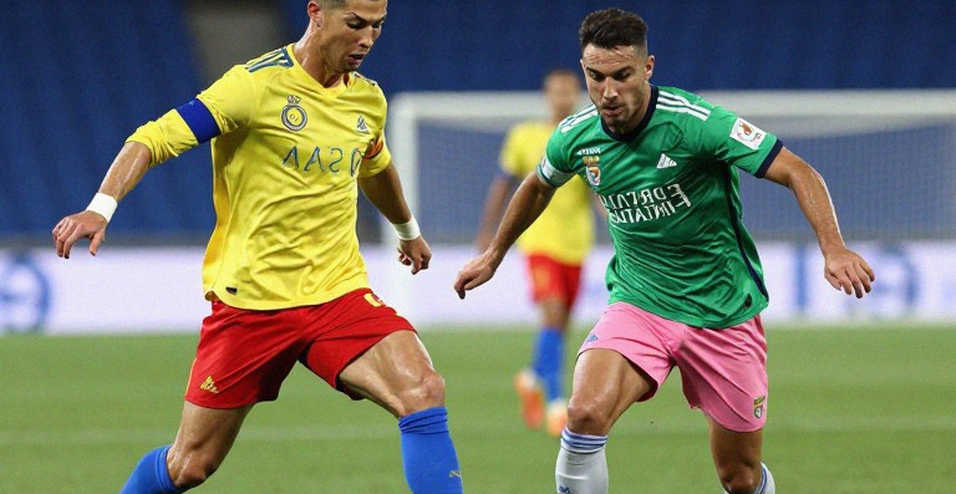
In the morning in Riyadh, on the grass of Al-Nassr's training centre, I stood about twenty metres from the fence and saw something I have seen thousands of times in nearly fifty years in this profession: a player walking onto the training pitch with a broad smile. Cristiano Ronaldo, at forty, rejoined his teammates after leaving the Portugal national team camp. There was no statement. No press conference. Just a photo, a smile, and a caption that was instantly replicated by news platforms across Asia and Europe into a story about crisis, defiance, and an international retirement. I looked at that photo for a long time. And what I noticed was not in the smile, but in the name that paper used for the man they claimed Ronaldo was ignoring.
When the new media come knocking loudly, I still hear the old drums from the stands. And today's old drum beats a very soft rhythm, enough for me to know that the story being told does not match the story taking place.
Let me tell it slowly, from the beginning.
The original article I read on Goal.com carried a headline built around a photograph: Ronaldo ignores Jorge Jesus's crisis with a broad smile. From the very first line, a confusion was planted: it assumed a "crisis" exists, that the crisis belongs to a man named Jorge Jesus, and that Ronaldo stands above it, serene, like an immortal saint above the noise of mortals. Three assumptions, wrapped in fourteen words. That is a very familiar way of building news in the era I live in: place an emotional frame first, then stuff the event inside, and if the event does not fit, trim the event to fit the frame.
But there was one detail I could not ignore, and it made me put down my pen, brew a cup of tea, and sit still for a few minutes. Jorge Jesus is a club manager. He has managed Benfica, Flamengo, Fenerbahçe, and most recently Al-Hilal in the Saudi Pro League. The head coach of the Portugal national team, the man in charge of the team Ronaldo captains, is Roberto Martínez, appointed in 2026. One is the captain of a club ship, the other the helmsman of a national ship. Placing two men in the same sentence, in the same crisis, is a mistake even an intern should not make. And yet it sits at the centre of an entire story.
I do not write these lines to catch a newspaper out. I write because I once made exactly this mistake, on a smaller scale but with a sharper pain.
Isco taught me that a name is not just syllables, but a whole person. In the summer of 2026, in Sochi, I sat in a television commentary booth for the Portugal–Spain match. I mispronounced Isco's name three times in the first half. Three times. The online community in China, where I live and work, mocked me for days on Weibo. That night I went back to my hotel and looked in the mirror for a long time. Not out of simple shame. But because I understood that when I call a person by the wrong name, I am telling millions of listeners that this person was not important enough for me to learn about. A wrong name is a disrespect, even when none was intended.
The following week, I rewatched the entire qualifying footage of thirty-two teams, noting the pronunciation of seven hundred and thirty-six players' names in their local languages. I built a personal biography database for each one, and from then on, I never wrote a player's name without checking their origin and native pronunciation. When I read that article, with the name Jorge Jesus placed beside Roberto Martínez and no one correcting it, I saw myself again in that Sochi booth. Only this time, the mistake sat at the centre of a story about a human being, and no one was held responsible for a name placed in the wrong place.
Now let us talk about football, because beneath the mist of media there is still real football.
Cristiano Ronaldo is currently a player of Al-Nassr, one of the leading clubs of the Saudi Roshn Pro League. He has just left the Portugal national team camp to return to his club. Al-Nassr are preparing for Round 8 of the league, facing Al-Diriyah on Friday evening. That is everything verifiable by dry fact. Everything else — the crisis, the ignoring, the international farewell — is the interpretive layer added by the storyteller, not by the player.
What caught my attention, and perhaps what young readers today rarely see, is that the structure of this story repeats a template long established in sports journalism. It follows four beats: an ambiguous event is discovered, a conflict is inferred, a figure is blamed, and an image is chosen to close every doubt. The final beat — the image — is the most important, because in a world of photographs, people believe what they see more than what they read. A man smiling at training, amid a story of division, is a perfect image: it evokes defiance, serenity, and resistance, depending on what the teller wants it to say. An image does not argue. An image simply exists, and lets others assign meaning to it.
I have seen this many times. In 2026, when I followed Shenzhen FC in China League One, a new platform published news of a training session just twenty minutes after it ended. The piece was two hundred words long and entirely omitted the financial crisis forcing the club to sell two key players. I wrote a five-thousand-word series on Shenzhen's supporter culture, based on a survey of three hundred people. Young editors called it long-winded and unattractive on digital platforms. That night I worried I had become outdated. But then I realised: the problem was not length, but that I was trying to tell a story about people while an entire system was trying to tell a story about a moment. Moments sell immediately. People need time.
I decided to stop chasing moments. I shifted to long-form analysis, but still opened with a specific situation and a specific emotion, because I understood that young readers do not lack information — they lack connection. And that connection I can only create by telling them about a person, not an event.
Back to Riyadh. The question I asked myself was not whether Ronaldo is angry with the national coach. My question was: if this crisis is real, whose is it, and who benefits from it being told this way?
Look at the power structure around Ronaldo. In the Portugal national team, he is the captain, the armband-bearer, the figure who gathers every gaze. At Al-Nassr, he is the centre of every media plan, the reason the stands are full, the reason sponsorship deals are signed. In both environments, power and value concentrate in one person. That is a model I call single-point dependency. It works in the short term, because a great star can lift an entire ecosystem. But it is fragile in the long term, because when that star leaves — through injury, age, or personal decision — the whole ecosystem must find a way to stand without him.
When a story is built around a player leaving a national camp, what people are really discussing is not the relationship between that player and the coach. What they are really discussing is the fear that the star will no longer be there. Every rumour about Ronaldo's international future, every absence from a match, every photo of him smiling at club training, is a chapter in a larger story: the story of a system preparing for the day it must live without this man.
And here I want to speak of what that article ignored, perhaps because it is too dull to sell: the fact that Ronaldo sat out the match against Norway. He did not play. No one said clearly why. It could be load management, a sensible rotation for a forty-year-old carrying the burden of both club and country. It could be injury. It could be a selection decision, even a disciplinary one. The article does not say. And that silence, to me, matters more than the smile. Because a real football story must begin from the question of why a player did not take the field, not from the question of why a player smiled.
I remember a September evening in 2026, when stadiums had been empty for seven months because of the pandemic. I met Dai Weijun, a twenty-one-year-old midfielder, shirt number twenty-one, sitting alone in the dressing room. He whispered to me: "Uncle, with no fans, I don't know who I'm playing for." The empty dressing room that day still carried the smell of grass and someone's tears. I did not simply record the words. I encouraged him to write an open letter to the fans, and the piece combining his words was shared fifty thousand times. The moment I helped him speak made me forget my own fear of being forgotten. I realised that companionship is a reporter's best weapon, better than any sensational headline.
That is why I do not want to write about Ronaldo's smile as an event. I want to write about the person behind the smile, and about the people trying to assign meaning to it.
Let us speak of the wider context, because this story does not sit in a vacuum.
The Saudi Roshn Pro League is a national project before it is a football league. It was built with the goal of projecting the country's image to the world, and its main tool is ageing stars from Europe. Ronaldo was the first and the greatest of them. When he arrived, a wave followed: players who had won the Champions League, who had worn national shirts, coming to end their careers under the lights of a rising league. I have followed this wave from its early days, and I must be honest: I do not think it develops football in the sense that pure football lovers expect. It develops something else — an image industry, where ageing stars become tourism ambassadors more than warriors on the pitch. That is not bad. It is simply different from what it claims to be.
In that model, Al-Nassr's value lies not in its style of play, but in Ronaldo's presence. Every training session with him is a media event. Every match with him is a sellable product. And when he leaves the national team to return to his club, that is not merely a personal decision — it is a flow of money toward Al-Nassr. The media report a crisis in Portugal, but what is really being re-centred is attention. And attention, in this league, is currency.
I do not have Ronaldo's Al-Nassr salary figures in hand right now, and I will not invent them. But I know the widely reported figure sits around two hundred million euros a year, and if that is true, then he is not merely a player of the club. He is the single largest return-generating asset on the club's balance sheet. That is a concentration risk any financial analyst would name: when one asset holds too large a share, any interruption to it — injury, international duty, even retirement — carries disproportionate financial exposure.
And here the story becomes interesting in another way.
If Ronaldo's international future is genuinely in question, as the article suggests, then the risk does not lie with the Portugal national team in the way people imagine. The real risk is a shift of value. If he leaves the national team, he has more time for Al-Nassr, and the club's commercial and competitive value rises. The national team loses its brightest star, but also gains a chance to restructure, to find an identity not dependent on one individual. The story the media tell is a story of a painful farewell. The real story, if we look closely, is a story of power and value transferring from one system to another.
I have watched too many seasons pass to believe in crisis stories built in a single day. A real crisis in football has a smell: the smell of a silent dressing room after a defeat, the smell of a manager sacked at three in the morning, the smell of a player sitting alone on the bench looking down at the grass. The crisis that article told has no such smell. It smells of ink and of an algorithm needing content.
Every transfer window is a farewell, but the heart of a club never leaves. And in this case, what is being dissected is not a transfer window, but a photograph. A photograph cannot part with anyone. It can only be misread.
There is one thing I want young readers to understand, because I have spent my whole life understanding it: football is made of people, not events. An event can be sold, spread, and forgotten within a week. A person stays. When I read that article, I did not see a player. I saw a misspelled name, a misread photo, and a system trying to turn a person into a product for consumption. And I wondered: if the writer had spent ten minutes checking the name of the Portugal head coach, would the story still have been told this way?
Perhaps not. Because a true story is harder to sell than a story with a crisis.
I come to the stadium not to score, but to keep the rhythm for the stories. And the rhythm of this story, to me, is a slow one. It begins on a morning in Riyadh, passes through a mistake about a name, pauses at a Round 8 match against Al-Diriyah, and ends at a question no one wants to answer: what happens to this system when the man who carries it on his shoulders is no longer there?
That article chose to answer with a smile. I choose to answer with an open question.
There is one detail in the original article I want to recall, because it reveals the wider picture the writer inadvertently exposed. The article mentions the Gulf Cup 27 final and Hervé Renard, the Saudi Arabia head coach. The fact that a story about Ronaldo sits beside a story about the Gulf Cup and a French manager working in the Middle East shows what I said from the start: this story belongs to a regional market, where football is seen through the lens of geopolitics, commerce, and national image. Ronaldo is not merely a player here. He is a symbol of a project far larger than himself.
And when a person becomes a symbol, people stop seeing the person. They only see what they need him to represent.
That is why I always try to tell the story from the human side. When I wrote about Dai Weijun in the empty dressing room, I did not write about a young midfielder. I wrote about a boy who did not know who he was playing for. When I write about Ronaldo at training in Riyadh, I do not want to write about a star. I want to write about a forty-year-old man, who has played football longer than many of us have lived, standing between two worlds: one that was once everything to him, and one that pays him a great deal to stay.
I do not know what he thought when he smiled at that session. No one knows, except him. And that is precisely the point where I want to stop: in an industry built on decoding people, the most honest thing a reporter can sometimes do is admit that he does not know.
But I do know one thing. I know that Jorge Jesus is not the Portugal head coach. And when a story is built on a wrong name, everything built upon it — the crisis, the ignoring, the farewell — stands on sand.
The new generation of reporters chase the ball; I chase what the ball has rolled over. And this ball, as it rolled over, left a faint trail I do not want to darken with speculation. It left a Round 8 match on Friday evening, a team trying to keep a positive run going, and a man preparing to step onto the pitch amid the singing of the stands — singing that, as I have said many times, is never copyrighted, and never belongs to any single name.
A stadium can change its name, but the singing of the stands is never copyrighted.
Tonight, when Al-Nassr walk out, I will sit in a corner of the stand, taking notes, and listening. Not to find a headline. But to find a rhythm. The rhythm of a team living in the moment of a star, and the rhythm of a star living in the final moment of a career. Those two rhythms do not perfectly align, and it is precisely in that misalignment that real stories are born.
I will not write about the crisis that article told. I will write about what I saw, what I heard, and what I cannot know. That is the only way I still know to keep the rhythm of my craft, after nearly fifty years.
And if you ask me to predict what happens next, I will answer with an internal signal, not a conclusion. Watch the next Portugal squad list. If Ronaldo's name is absent, then the real story has begun, and it will begin in a place none of us are looking at. If his name is present, then the crisis the media told was only a gust of wind, and it will pass as quickly as it came.
For now, on the training pitch in Riyadh, a man is still smiling. And I am still listening, slowly, as I have listened all my life, to the old drums beating from a stand whose name no one remembers.
He wore a new shirt, but I still remember the way he tied his boots on the first day. And perhaps that is all I need to remember to keep writing.
Cầu thủ liên quan
Bài đề xuất
The 78th Emmy Awards: The Last Word of a Cancelled Show2026-09-16
Al-Shahrani Reaches 213 Wins: Headline Says Broken, Data Says Equalled2026-10-17
Filtering Transfer Rumors: The Young Look at Transfermarkt, I Look at the Player's Eyes2026-10-16
Ten Hag, Neville, Ferdinand and the 'Prestige Tax' Mechanism at Old Trafford2026-10-22
NBA Expansion 2028: Mexico City Trails Las Vegas and Seattle for Structural, Not Market, Reasons2026-10-24
Bài đề xuất
Alex Scott and the 118 Million Euro Figure With No Signature2026-10-15
When the Data Sheet Is Empty, People Are Still the Answer2026-10-11
The Silent Crack in Mid-Season2026-10-11
An Empty File Tells the Truth: Youth Scouting and the Temptation of Fabricated Stories2026-09-22
Mathew Baker Rejected Australia to Play for Indonesia: The Decision Was Never About the Heart2026-10-20
Bài đề xuất
Gabriel Bontempo and Beşiktaş's €12 Million Puzzle2026-09-21
Marcos Leonardo at Ajax: 20 Million Euros, 343 Minutes and an Unresolved Fitness Test2026-10-12
Cristiano Ronaldo Leaves Portugal Camp: Inside the Transition Nobody Wants to Name2026-10-04
One Point of Pressure and the Shadow Behind Rangers' 4-0 Win2026-10-25
Al-Shahrani Reaches 213 Wins: Headline Says Broken, Data Says Equalled2026-10-17